 Army Ornithological Society
Army Ornithological Society Blog
Cyprus Weekly
The Army Ornithological Society Tour of Cyprus 22 – 30 March 2014


This Week’s Birding Highlights will take the form of the Trip Report of the Army Ornithological Society’s tour of Cyprus from 22 – 30 March.
The report will adhere to the following format:
• Introduction
• Acknowledgements
• Daily Itineraries with Birding Highlights
• Consolidated Species Trip List
• Summary
The Group – Akhna Dam 30 Mar 14

(L-R) Roger Dickey, Andrew Bray, Tony Kaduck, Mike Williams, Mark Easterbrook (Leader), Richard Seargent, Dave Pentelow & Andy Harrison
Courtesy of Roger Dickey
Introduction
It started with an arrival which was reminiscent of the retreat from Moscow and ended with a finale that nobody could have predicted. In between there were great views of birds, some disappointing dips, the highs and lows of birding but most of all great company, a common purpose and a very fulfilling and enjoyable tour. Covering 1048 miles during the tour, which is a lot in Cyprus, all of the main habitats and sites were included with the exception of the Polis and Lachi areas which would have required a 10 day tour to do the areas justice.
Acknowledgements
• Roger Dickey – For his part in the planning and advice given during the recce of Feb 13.
• Colin Richardson – For his advice/suggestions for birding success, the Cyprus Scops Owl and his company during the tour.
• Debs Easterbrook – OC Rear Party – for dealing with necessary admin to ensure the tour ran smoothly in the group’s absence.
• The “Crew” – For their commitment, stamina and light hearted view of life, despite the lack of coffee.
Daily Itineraries with Birding Highlights
Day 1 – Saturday 22
No birding took place today as the 3 different flights from the UK arrived in the late evening. After a slightly disjointed arrival process the team were formed and on route to Ayios Nikolaos (Ay Nik) for 2 nights and the first phase of the tour. After arriving in the accommodation, bags were dropped and we all ate at the local grill restaurant where much pork, sheftalia and chicken was eaten, all washed down with several KEOs. A good night’s sleep on a full belly and ready for the inaugural trip to Cape Greco in the morning.
Day 2 – Sunday 23
Cape Greco can be a bit hit and miss as with any migrant hotspot, but today it was an outstanding intro to Cypriot birding. Checking the Cape Greco Pines area the first bird that was heard and seen was an Eastern Bonelli’s Warbler and several Hoopoes flushed from the ground – a good start. As we walked the area it became clear that there’d been a large influx. Wrynecks were seen well with Tree Pipits, Eastern Orphean Warblers and a female Pied Flycatcher as back up. The ploughed fields in at the Cape gave opportunities to get fantastic views of Cretzschmar’s Buntings, Water Pipits, Tawny Pipits, Corn Buntings, Isabelline, Northern and of course the endemic Cyprus Wheatear. We continued to walk under the Army Camp cliffs where 2 late Black Redstarts were joined by a Common Redstart, Eastern Bonelli’s Warbler and a male Siberian Stonechat. Blue Rock Thrushes, Ruppell’s Warblers and Spectacled Warblers were everywhere and we soon discovered a single female Ortolan Bunting. As the group watched a couple of Eastern Subalpine Warblers another sylvia came into view and showed very well giving everyone perfect views of a male Cyprus Warbler – pressure off, both endemics in the bag on the first morning.
We continued towards the sea caves from the Army Camp and as we rounded a corner I heard what I thought was a Coal Tit. I saw it in the bins and it was darker and longer than the endemic race that do not leave Troodos. I called Richard over and said “What’s this”? He nonchalantly replied “A Coal Tit” – obviously thinking I’d lost it. The group viewed the bird and concurred it was a Coal Tit – Eurasian Coal Tit! The first record for Cyprus. With other birds on their minds, it took me a while to ensure they realised the importance of the find which would require a description – unfortunately the bird was very flighty and as we attempted to get closer for a photo – it did one.
We drove to Ayia Napa Football Pitches on a speculative search and as we drove up I pointed out a target bird on the fence – a stonking male Masked Shrike which was admired by all. Continuing to the famous Ayia Napa Sewage Works we walked around and Tony spotted a black and grey Shrike which proved to be a very early Lesser Grey Shrike. We eventually tracked down and secured great views of a male dark throated Eastern Black-eared Wheatear, with more of the same migrants we’d seen earlier. A Common Sandpiper was on the lagoons and as we left I broke hard to allow the group to see and photograph a male Siberian Stonechat*. We ate our packed lunch at Ayia Thekla but sadly no wintering Greater Sand Plovers remained.
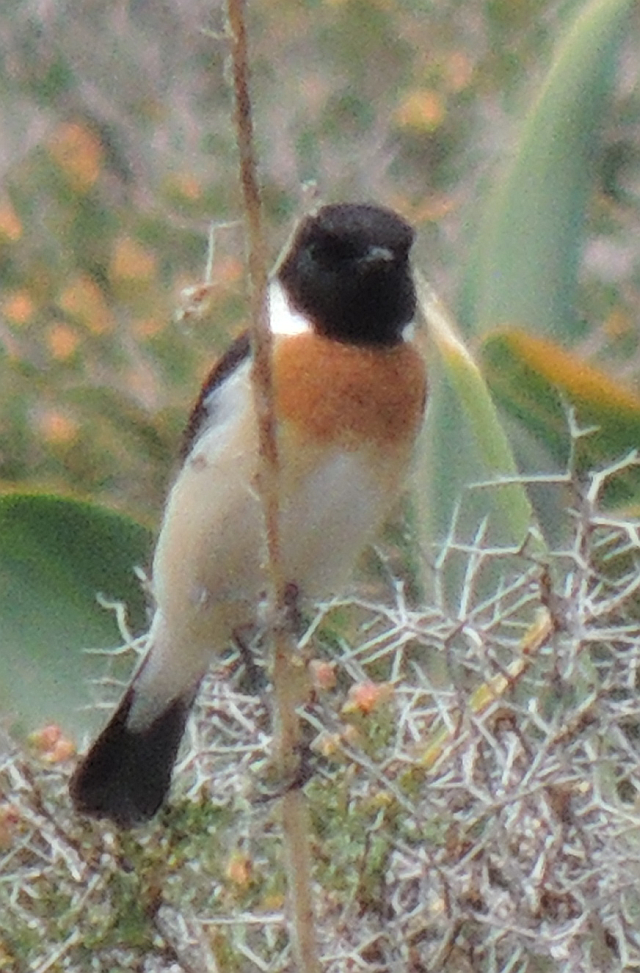
Siberian Stonechat – Ayia Napa Sewage Works
After lunch we continued to Paralimni Lake and Sotira Pond where a Yellow Wagtail fest ensued. As we grilled them we saw Black-headed (feldegg - the majority), Blue-headed (flava), a single Grey-headed (thunbergi) and many hybrid supercilliaris forms. Suddenly, the birds took flight and as we watched a ringtail Pallid Harrier complete with neck collar was the cause. The Wagtails settled and Dave Pentelow called a superb male Citrine Wagtail – it just kept getting better! Eventually, Tony Kaduck found a supercilliaris with a yellow supercillium making it a xanthrophis hybrid – a rare form but sadly it was only seen by one other. Spanish Sparrows and Corn Buntings were numerous and the Spur-winged Plovers gained the usual attention afforded to them when they’re first seen. It was time to move onto Akhna Dam to finish off the day. Although there wasn’t much here we added Bluethroats, Ruffs and a lone late wintering sinensis Cormorant. Sadly, here a Starling was suppressed and the culprit shall be berated for ever more – it was the only one of the tour and would have added to the group total. I stopped in the local village for the final bird of the day - a Little Owl.
Day 3 – Monday 24
The Larnaca area beckoned and with 83 species in the bag on day one it was going to be a tough act to follow. We paused at Dolphin Rocks, Oroklini Coast initially and our luck was in with 5 Sandwich Terns and 2 Baltic Gulls being on the rocks amongst the reducing Black-headed Gulls – the list was moving. It’s all about the list you know? We drove the short distance to Oroklini Marsh and the new hide and started to find new birds immediately with 4 Black-tailed Godwits, numerous Black-winged Stilts some over wintering wildfowl including Pintails, Shovelers, Teals with the stars being breeding Red-crested Pochards that were viewed by all. 12 Greater Flamingo remained and a Snipe crept from the undergrowth. No time to waste, to the Larnaca Sewage Works and Airport Fields area. As is the norm, many Black Francolins could be heard and we flushed 5 as the mini-bus passed but views were not good enough for such a target bird. At the sewage works the only Armenian Gull of the trip – an adult, along with 1st winter Caspians, a single Slender-billed and a surprise 1st winter Little Gull. 3 drake Ferruginous Ducks were a bonus here and eventually we located a calling Black Francolin which was seen well by all – “tick” another target in the bag.
We stopped at Pervolia on the way to Petounta Point for what was described as a “drive-by” Calandra Lark. I had previously located a cereal field where 2 birds had been displaying. As we drove up, sure enough I could here them. We stopped the crew alighted and I pointed out the large Larks with dark underwings, white trailing edges and a bubbling liquid song flight to the assembled audience. All took in the relevant features and were content – how is that “drive-by”, I call it a judicious use of valuable time and good planning!
At Petounta, although relatively quiet, in the marsh we saw our first Wood Sandpipers, heard a Water Rail, Great Reed Warbler and Lapwing and secured more great views of a fine Citrine Wagtail*. On the upper rocky areas we grilled Isabelline, Northern and Eastern Black-eared Wheatears in the hope of a Desert Wheatear – but no joy. Back at the marsh, more Yellow Wagtails but nothing new and close views of a flock of Greater Short-toed Larks and a couple of Red-throated Pipits. Transiting back through Larnaca to the next site we stopped at Larnaca Airport Pools North where we saw 4 Greenshanks, 149 Greater Flamingos (yes, sadly I counted them), and circa 20 Slender-billed Gulls with a few more on the Salt Lake and our first Great Tit next to the Hala Sultan Tekke Mosque. I offered a visit, but the uncultured “A” Team were more interested in birds – can you believe that?
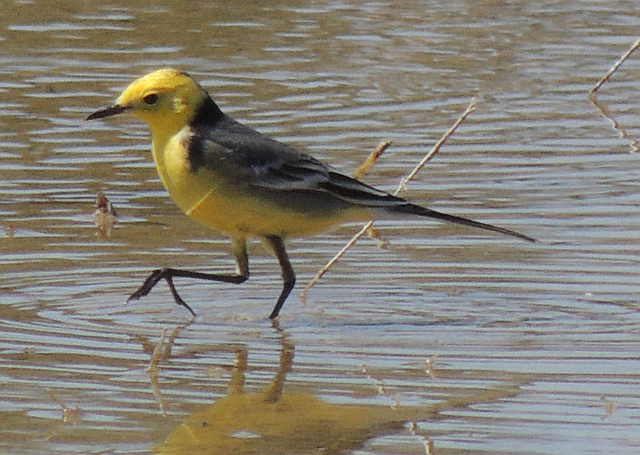
Citrine Wagtail – Petounta Point 24 Mar 14
We arrived at the north side of the Salt Lake and as we walked, flushed a Green Sandpiper. We walked across the now dry salt lake to view a remaining puddle which held some waders. Advancing further to reduce the considerable heat haze, we scoped the waders where Dunlins and Ringed Plovers – the only ones of the trip where in the majority. As we scoped, Ruffs and Little Stints became apparent. Then Tony “chipped in again”, as he found 2 Sanderlings which were most unexpected for the trip but a great addition to “The List”.
We then drove to one of my favourite self-found sites which always turns up something – Larnaca JUMBO drain. Sure enough and running true to form a Temminck’s Stint and a few Little Ringed Plovers with several Common Snipes. A sharp “shrrreeeep” call alerted me to another male Citrine Wagtail – I’ve never seen so many in a spring. Then Richard found one of the birds of the tour – a female Little Crake bathing and feeding in the open next to the smallest of reed beds – I LOVE JUMBO DRAIN!!!!

Little Crake – Larnaca JUMBO Drain 24 Mar 14 Courtesy of Roger Dickey
We continued to Oroklini Marsh but this time the southern end, as its great Wader habitat and I had a bird in mind. In a MR Ben (for those that remember him) type way, as if by magic the shopkeeper appeared – no sorry the Marsh Sandpiper appeared with 5 Ruff and another was seen later – RESULT and the only ones of the trip. After many hints about coffee related colours and birds etc, I relented and stopped at the Dolphin Rocks café for an afternoon coffee break – I never thought it would come to this, but such was the relentless moaning and winging (mainly from our colonial and chairborne contingent, who were suffering withdrawal symptoms) that I relented. After a short stop we moved to the last site of the day Akhna Dam. We immediately scored with a migrating flock of Night Herons about to roost for the night. Another Greenshank, several Redshanks and a Common Sandpiper nearly finished the day but around the corner in a small pond, some Little Stints and another male Citrine Wagtail – amazing numbers. With the totals now in excess on 100 after 2 days, things could not have gone better. A curry and chilli night around my house, coordinated by OC Rear Party went well and was naturally all washed down with several KEOs – there’s a pattern forming.
Day 4 – Tuesday 25
Phase 2 of the plan commenced with a road trip to Troodos for an overnight stay stopping at Akrotiri, Episkopi and the Dhiarizos River Valley on the way. The best laid plans were interrupted by an enforced early start and late departure due to the news of a Caspian Plover at Paralimini Lake. So we attempted to twitch it. A very early bird (usually seen in April), it would have been a great addition and lifer for most on the trip. Unfortunately despite extensive searching and gnashing of teeth the bird had departed. We did add the first Purple Heron of the trip though and heard a couple of Quails. We had an uneventful journey to Limassol and arrived at the Port Canal in an attempt to see the White-breasted Kingfisher which was unsuccessful and indeed this bird along with Bimaculated Lark consumed valuable time on the tour and became our nemesis. We did however see Common Kingfisher, Sedge Warbler and the Laughing Dove that I’d seen a couple of weeks previously remained faithful to its telegraph wire. On the way to the new Zakaki Marsh hide 4 Common Buzzards (the first for the trip) circled above us and at Zakaki were joined by a Marsh Harrier. Zakaki was fairly quiet but a Little Egret, Kingfisher and amazingly another Citrine Wagtail broke the boredom.
Driving along Lady’s Mile was fairly dull so we parked about a mile from Akrotiri Salt Lake, as I didn’t want to suffer the indignity of getting bogged in and walked to the waters edge. Circa 30 Shelducks were present with about 250 Greater Flamingos and careful scanning revealed the only Great White Egrets of the week amongst 129 Grey Herons – Yes I counted them. I scanned the many Kentish Plovers and alerted the team to an interesting bird; we needed to move closer. Finally in position I directed the group onto a pair of Greater Sand Plovers in breeding plumage, complete with orange breast band. Interestingly, their bills were large and noticeable even at distance making them the migratory species crassirostris and not the regularly wintering sub-species columbinus. As all the wintering birds had departed, this was the only chance of the species so it was a real bonus bird on the list. I had earned my fee again – Ah forgot, there isn’t one but at least I wasn’t getting grief about coffee stops – thank heavens for small mercies. We proceeded to Bishop’s Pool and climbing over a fence got access. A good count of 13 Ferruginous Ducks were present and a Purple Heron perched in the open and was joined by another as they alighted. An Eastern Bonelli’s Warbler was seen when leaving the site and we had lunch in the Akrotiri Orchid Glade – well some of the more rounded members of the group enjoyed it but we did add our first Sardinian Warbler of the week.
We drove around Akrotiri Gravel Pits seeing a Wryneck in the Church gardens and a Marsh Harrier nearby. Phassouri Reed Beds was quite disappointing with only 5 Cattle Egrets being present so we proceeded to Episkopi and Kensington Cliffs. The wind had got up but we did have extremely good views of our first Long-legged Buzzards and only Alpine Swifts of the tour. However, the resident Griffon Vultures were conspicuous by their absence so another visit would have to be vectored in when returning from Paphos. At Kouklia Soakaways another Long-legged Buzzard was seen and as we drove to Troodos via the Dhiarizos River Valley another couple were seen. As we drove up the valley floor a couple of Great Spotted Cuckoos were seen – it’s a good year for them and was appreciated by all, much better than dipping in Pembrokeshire. Despite checking the known wintering sites for Finsch’s Wheatear sadly for the crew they had all departed about a week prior to their arrival. Moving up the valley there was a lot of raptor activity on the hillside above Kadares with a male Pallid Harrier, Long-legged Buzzard and a Kestrel. Tony alerted me to anther bird which mysteriously morphed into a Kestrel but his persistence paid off and with a large puff-ball looking white rump and accipiter wing shape, it was the most difficult of all the resident raptors to see – a Goshawk. The decision I’d taken to drive the long way to Troodos as opposed to up the normal Limassol route had very luckily paid dividends. We arrived at Troodos Environmental Centre at about 1730 and with the sun still up, although much cooler than the lowlands I speculated that we should give some of the island’s sub-species endemics a whirl. Within 20 minutes we had secured good views of Jay, Coal Tit, Short-toed (Dorothy’s) Treecreeper and Blackbird with Pallid Swifts above us. Four of the 6 sub-species had been seen. We had dinner in the Troodos Hotel Restaurant which was enjoyable and went to bed listening to calling Cyprus Scops Owls and Andrew secured a view of one.
Day 5 – Wednesday 26
All hands to the pump for the remaining sub-species. We visited Giant Juniper Picnic Site and had walked about 500m gaining more views of the birds we had seen last night and adding Chaffinch to the list, when I heard some Crossbills above us. Eventually, the group got views of a male and 2 females feeding on the Black Pine cones. One of the more difficult birds to see, I was very pleased. Job done, we continued and came across a brilliant male Masked Shrike that was early on its breeding grounds and I feel sure the fast growing “David Bailey” contingent got some good images – may I remind you, THIS IS NOT A PHOTGRAPHIC TOUR, DO NOT FLUSH THAT BIRD! We continued, a short distance to Levadi Tou Pasha Picnic Site. All quiet, a Eurasian Wren tape was played which incited the resident to wake up and start singing moving from tree to tree. Great views of the last endemic sub-species and my pre-tour promise had been fulfilled – Both endemics and all the sub-species endemics.
We headed off to Prodromos Dam in search of a Grey Wagtail. This was unsuccessful as it would appear that the wintering population had departed. We did however get the last target bird of Troodos in the form of several singing Serin, 2 of which were in display flight. Once more, the crew’s thoughts turned to Coffee and the relentless pressure caused me to keel in and stop at my favourite café in Troodos, the Ben Nevis. Here we enjoyed great coffee, Apple Pie and Chocolate Cake. I know – what sort of an outfit am I running. It was like a dudes’ day out at Titchwell. Stopping at the much frequented nut stall before departing Troodos, many varieties of nuts were purchased amidst the usual stall holder’s banter about Viagra, eroticism and generally inappropriate sales pitches in the promotion of nuts. On the way down we paused at the Caledonian Falls in the hope of a Grey Wagtail but were unsuccessful but did see another Wren.
We travelled down the Dhiarizos River Valley in the reverse of the ascent. We paused at Kadares once more and right on queue, a superb adult Long-legged Buzzard showed all of the necessary ID features in beautiful sunshine. A little further down opposite a cliff face, I stopped as Roger and I had seen a Peregrine nearby in the recce of Feb 13. Extraordinarily, we first heard a Peregrine and then witnessed the “shift-changeover” at the nest site, the bird stooping and displaying twice, what a fantastic moment for the group. Time in recce is never wasted! Then, another stroke of luck as 3 Griffon Vultures passed over the cliff saving me a regain on the return trip, which would allow us another crack at the White-throated Kingfisher and a visit to another site. We stopped at the Extreme View Café for lunch and the breeding Red-rumped Swallows performed well for the group.
We departed after lunch for Mandria in the hope of finding the Bimaculated Larks that had been there for a few days – another dip, this was becoming an uncomfortable habit, we did see 15 migrating Black-winged Stilts offshore and the only Shag of the trip sat on the rocks. The fields contained the by now familiar Wheatears and Pipits. With morale ebbing, we drove to Anarita Park as Colin Richardson had joined us at Mandria and suggested it might be productive. What a great decision. As we drove in a couple of Eastern Black-eared Wheatears were seen and as we stopped and exited the vehicle a Stone Curlew flew and then posed for the assembled scopes. A Little Owl perched in the open on a rock, Great Spotted Cuckoos flew by and a Hoopoe put in an appearance. A male Blue Rock Thrush was higher up the valley on a rocky scree slope and then “2IC Bagging Birds” Richard found a cracking male Rock Thrush or Rufous-tailed Rock Thrush if you prefer. We decided to move further up the valley and secured fantastic views of this scarce and difficult to catch up with migrant as it went about its business. Birds were moving everywhere and we saw Cretzschmar’s and Ortolan Buntings and discovered the “Bush Of Love”, so named as it seemed to attract every bird in the area. A small leafless dead bush attracted the Buntings, Blackcaps, a lone female Chaffinch, Lesser Whitethroats and Eastern Subalpine Warblers – what a great site and enjoyable hour and a half. As we left another male Rock Thrush sat on telegraph wires – like number 10 busses.

Rufous-tailed Rock Thrush – Anarita Park 26 Mar 14
We finished at the Paphos Lighthouse, where some Yellow-legged Gulls loafed and the Black-winged Stilts had made their way around from Mandria. With a nutter walking on the headland contemplating the meaning of life and flushing everything we checked into the hotel. A near mess up with the booking (not my fault, before you start), had me visibly agitated, I think the phrase is - as an LE Officer, I don’t do poor admin. Anyway, all resolved we booked in without difficulty and left the hotel for Colin Richardson’s house and the chance of a Cyprus Scops Owl. As we arrived we could hear the Owls in his garden but they then flew and stopped calling – Sods Law. We travelled down the hill slightly to the village of Armou where at least 6 were heard calling with their double noted, different to the nominate Eurasian Scops Owl’s call. Eventually, we got one calling in the torch light and very good views were achieved of this most enigmatic of owls, that will surely be split. We returned to the hotel, did the call-over and went to Tramps Bar, where we had a few beers and supper and thanked Colin for his help as we bought him dinner. We will not mention the leader waking up confused and having a nightmare whilst screaming at Dave Pentelow who started screaming back until the initiator woke up – or will we? Very comical, but we’re all friends here.
Day 6 – Thursday 27
Refreshed we rose early and the Kings Hotel had kindly provided a full Greek style early breakfast. We headed for Mandria for another bash at the Bimaculated Larks which was unsuccessful. As we walked the area an extroverted Wryneck gave crippling views for everyone as it fed actively on the ground. A Greater Short-toed Lark, Tawny Pipit and Red-throated Pipits gave excellent prolonged views and the ever present Black Francolin called nearby. We drove to Asprokremnos Dam, where Colin Richardson joined us and walked the pines where an Eastern Bonelli’s Warbler and male Pied Flycatcher were seen. Many Tree Pipits were present and 13 roosting Night Herons flushed as we walked the area. The day had been set aside to achieve views of Bonelli’s Eagle and perched views of Great Spotted Cuckoos which all were keen to achieve. We stood at a good vantage point above the dam. As we watched we noted Marsh Harriers, Common Buzzards, Red-rumped Swallows, an Eastern Black-eared Wheatear, the only Montague’s Harrier of the trip and a single Pallid Swift. Then, the shout went up and eventually everyone was securing good views of a sub-adult Bonelli’s Eagle. That one in the bag we drove up the Dhiarizos River Valley to Kidasi once more. Soon we were viewing perched Great Spotted Cuckoos and once more at Kidasi a Peregrine was visible on the nest and a Blue Rock Thrush was close by. Bonelli’s Eagles were seen again and as we ate lunch at the Extreme View Café more Bonell’s Eagle views and the sight of 11 Griffon Vultures spiralling over the hillside (probably the whole of the wild Cyprus population). The afternoon became very hot and we moved from site to site without really producing anything of much interest. As enthusiasm was dwindling and people were wilting in the heat, I turned to the tour guides best friend – coffee, beer and a rest. Two in a day, I hear you say and so did they – I must be getting soft? From Mandria we drove to the coast at Paphos in a speculative bid to “make something happen”. As we arrived and started to walk, a Whimbrel flew by – a rare bird in Cyprus and it was extremely fortunate timing that we added this to the trip list – although I put it down to good decision making and planning! Then, missing Garganey from the list Richard found a drake flying up the coast which everyone managed to get onto. The trip list continued to grow unabated.
Day 7 – Friday 28
After sleeping off a Meze and some more protein (Cyprus doesn’t suit the vegetarian option) an early departure from Paphos had us grilling the area at Mandria once more for a Bimaculated Lark – without success once again. Red-throated Pipits were evident as was a Tawny Pipit and a Black Francolin called in the distance. Alas, it was time to go and the Bimaculated Lark had lived to fight another day, however we did see a cracking Ruppell’s Warbler as we left the area. We continued to the Limassol Port Canal in the hope of seeing the White-breasted Kingfisher that had been previously reported and eluded us. Again without success and I don’t like dipping twice in a day, we moved on through Lady’s Mile to Akrotiri Gravel Pits. Save for a Masked Shrike, Eastern Orphean Warbler, Eastern Black-eared Wheatear and a ringtail Pallid Harrier, there wasn’t that much to get excited about, especially for the by now seasoned Cyprus birders desperate to increase the trip list. After lunch we made another effort for the Kingfisher and dipped again but did see the Laughing Dove once more before we departed. Stopping at Finikaria, a village on the north side of Germasogeia Dam it looked pretty boring and was until out of the bag – the first Squacco Heron of the year and only one of the tour – result! We drove straight to Oroklini where we added another 2 trip birds with a pair of Glossy Ibises and a Spotted Redshank amongst the many Black-winged Stilts. An impromptu stop at Akhna Dam before returning home for a BBQ was rewarded with a Cuckoo and a breeding plumaged Black-tailed Godwit and as we left a pair of close Great Spotted Cuckoos. The day hadn’t turned out too badly after all! I say that because, at the BBQ having quaffed beer like it was going out of fashion, I thought people might like a “wee snifter”. Had I realised that the group were actually a bunch of Jura “Superstition” consuming drunks, I may not have followed this course of action. Not content with that they also demolished my other bottle of Glengoyne “Burnfoot” Malt. I went to bed feeling violated – but it was a good night and once again thanks to my wife for making it happen without a hitch.
Day 8 – Saturday 29
With time running out and wishing to catch some more migrants we headed to Cape Greco. Whilst more exceptional views of birds such as Ruppell’s Warbler and Masked Shrike were achieved there was nothing new for the trip, although noting the plumage differences of 2 female Siberian Stonechats was an interesting moment. 12 migrating Little Egrets and 2 Kingfishers were at Kermia Beach and at Ayia Napa Sewage Works more Masked Shrikes and a cracking Eastern Black-eared Wheatear. Paralimini Lake was disappointing so we moved to Akhna Dam where nothing much had changed from the day before although a White-Spotted (cyanecula) Bluethroat was seen. After an admin period we departed for the north at 1445. At Gulserin Pond a few Little Stints were on offer and at Clapsides Beach, good views of very pink Slender-billed Gulls were enjoyed. On route to Fresh Water Lake South, the alert driver pulled off the road and pointed out the first Woodchat Shrike of the trip, thus avoiding a blank day. The rest of the team were obviously already on the aircraft on the way home and so needed to receive the “Lets focus” speech – we still have birds to see. We proceeded to Fresh Water Lake South to view the 400 or so strong Cattle Egret colony – a spectacle in itself where 4 Night Herons and 2 Little Egrets were also present. On Saturday evening we enjoyed a farewell Meze at a local restaurant which was great value for money and enjoyed by all. Deb and I thank you for our dinner.
Day 9 – Sunday 30
With a real “hooley” of a wind blowing all night from the east, Cape Greco had much to promise. However, it didn’t quite turn out that way. Migrants were keeping low in the wind, so offshore a Sandwich Tern flew by with a Baltic Gull and several Yellow-legged Gulls. In a lull in the wind, the regular singing male Cyprus Warbler performed well for the crowd which was a bonus. As the wind dropped a little, a Cuckoo came in off the sea and I suggested that we looked under the Army Camp cliffs for birds that may be attempting to shelter from the wind. We had walked about 600m and the team were alerted to a movement that turned out to be a White-spotted (cyanecula) Bluethroat. Several mentioned a Cyprus Wheatear but were distracted by the Bluethroat. On closer inspection it proved to be a pristine male Hooded Wheatear. A Cyprus mega (the 21st record), and a lifer for most members of the trip and a Cyprus “tick” for me. It fly-caught and sallied, in typical Hooded Wheatear style, within 5m of us and allowed for some excellent observation of the key features and photographs. Another Cuckoo was seen and a male Cretzschmar’s Bunting before we headed off to Ayia Napa Sewage Works via Cape Greco Pines where an Eastern Bonell’s Warbler and Eastern Black-eared Wheatear were present. The sewage works didn’t have much to offer so we went for a typical Greek lunch at Ayia Thekla. After lunch we visited the final site of the trip – Akhna Dam. A couple of Common Sandpipers, the ubiquitous Zitting Cisticolas and Cetti’s Warblers were on offer but little else. We headed to the airport seeing Greater Flamingos at Oroklini Marsh before the team were eventually dropped off, thus ending a fantastic tour.
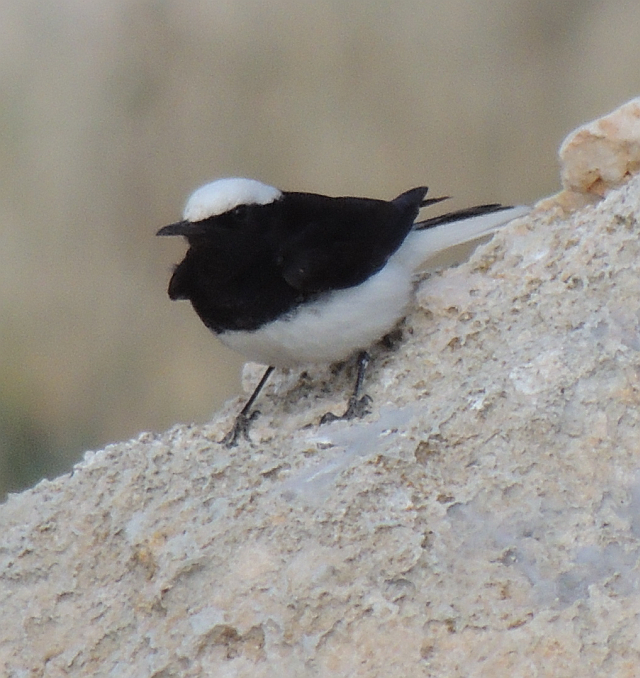
Hooded Wheatear – Cape Greco Cliffs 30 Mar 14 – 21st Record
Consolidated Species Trip List
Summary
An outstanding effort from the team! For this time of year the total it is unlikely to be surpassed. A combination of good planning, luck and commitment ensured that a total was seen that exceeded expectations by far. Furthermore, most of the group saw all of the birds, however as is the norm, inevitably some did not see all. That said, all the key species were seen and extremely good full frame views were enjoyed by all. I would like to take this opportunity to thank all who attended for their contribution and making a tour of like-minded individuals so easy to lead. I would also like to thank the group for remembering my wife (OC Rear Party) for her considerable contribution in ensuring all ran smoothly and to the group for replacing my Whiskey which they enjoyed quaffing. Remember, looking for birds in the wind “Is as much use as a “Handbrake on a Submarine” – most of the time.
Highlights of the Week: Amongst a host of great birds, the first Eurasian Coal Tit for Cyprus, good views of Siberian Stonechats but the 21st record of a stunning male Hooded Wheatear (a lifer for all but Dave Pentelow and me) stood out and was a fitting finale to an excellent week.
If you are planning a visit or require more info please feel free to contact me at: birder639@yahoo.com
Mark Easterbrook
CommentsCyprus Weekly
Birding Highlights for the Week Ending 23 Mar 14
Collared Flycatcher at Cape Greco Pines on 17 Mar

A quick Monday evening trip to Sotira and Paralimni Lake revealed the arrival of many Lesser Whitethroats and my first Sedge Warbler was seen. 4 Black-winged Stilts are now on the ponds and a Wood Sandpiper flushed as I arrived. Yellow Wagtails were also present in good numbers with the majority being Black-headed with a few Blue-headed and several supercilliaris hybrids.
On Tuesday afternoon, I visited the Cape Greco are in the hope of finding arriving migrants. I wasn’t disappointed. Arriving I immediately saw my first Eastern Black-eared Wheatear of the year perched on a dead snag. As I progressed to the point, Northern and Isablelline Wheatears were present in good numbers with a supporting cast of Black Redstart, Blue Rock Thrush, Tawny Pipit and a Hoopoe. As I walked the coastal path another dark throated Eastern Black-eared Wheatear was present with a Ruppel’s Warbler. Above me 21 Cormorants made their was north eastwards. At Cape Greco Picnic Site I was relieved to find 2 singing male Cyprus Warblers, on of which was joined by a male Ruppel’s. I then thought I’d have a quick walk around the Cape Greco Pines area. It wasn’t a quick walk around – the place was heaving. 4 Hoopoes were on the ground and I saw the red tail of a Redstart. I eventually got good views of an early Common Redstart male – Ehrenberg’s usually being present at this time of year. As I moved, another bird gave a flash of black and white. I got on it and was amazed to find a Collared Flycatcher* – at least a month early. I secured not bad photos under the circumstances and moved on. Another flycatcher moved amongst the pines and this was a male Pied Flycatcher – even earlier. I continued to walk around finding a female Pied Flycatcher and another male Collared. With 2 also being reported from Akrotiri, there seems to have been a very unusual early movement of the species. Coupled with the arrival of numerous Vagrant Emperors, associated with North African sand storms (which we’ve seen the tail end of this week), perhaps this explains the bird influx.
I continued to the sea caves finding another 2 Eastern Black-eared Wheatears, this time light throated forms with 2 Isabellines, 2 Northerns and a female Finsh’s. With 3 Cyprus Wheatears on territory only a Desert missing. I photographed 2 Ruppel’s Warblers* there were 5 in total and a couple of Lesser Whitethroats before seeing a singing male Blue Rock Thrush, attracting a female and a Black Redstart. With migrants in mind, I moved on to Ayia Napa Sewage Works. A Northern and Isabelline Wheatear greeted me. I moved around the vegetation being attracted by a singing Eastern Bonelli’s Warbler and as I walked flushed a Common Nightingale. 3 more Eastern Bonelli’s were in the area along with a couple of Lesser Whitethroats, 3 Willow Warblers and at least 6 Song Thrushes. At Paralimni Lake on the way home, Yellow Wagtail numbers had reduced, Green Sandpipers numbered 7 with Little Ringed Plovers totalling 6. Another couple of Lesser Whitethroats performed and a Sedge Warbler sang. I flushed a Hoopoe whilst departing for home.
Wednesday was a silver lunch in the mess so I was unable to get out. On Thursday, I took a day’s leave to visit the north in search of an Orchid. I met with my contact and after a coffee and a chat I was photographing an Ochris anatolica (Anatolian Orchid)*. Another that I’d missed last year and seemingly it only exists in the north of the island. So down to 9 to see on the Cyprus list – a fairly good effort. I stopped on the way back at an Alpine Swift site and 5 were present. Up over the top via Kantara Castle and along the road on the way to Bogaz a Little Owl and a Cyprus Wheatear. I stopped in the Famagusta area and at Gulsering, Dunlins, Little Stints and Ringed Plovers but not much else. Fresh Water Lake South was very quiet with only 11 Cormorants, the Cattle Egrets a single Grey Heron and Little Egret with a female Marsh Harrier flying through. In the evening AOS accom admin and stocking the beer fridges.
On Thursday, I visited the north to see an Orchid – Ochris anatolica (Anatolian Orchid) as it was another that I hadn’t seen last year. This was successful and I saw several Red-rumped Swallows and 5 Alpine Swifts at a known breeding site. On the way home through Bogaz a Little Owl was on a rock and a Cyprus Wheatear nearby. On Friday Akhna Dam produced the now common waders such as Ruff, Wood and Green Sandpipers with a selection of Yellow Wagtail species. 2 Bluethroats were probably migrants and the Great Crested Grebe remained faithful to the site. 2 Stone Curlew that are unusual for the site flushed as I walked but there wasn’t much to get excited about.
On Saturday morning I visited the Cape Greco area as a recce for day 1 of the AOS tour tomorrow. Plenty of migrants were about including Eastern Subalpine Warbler, Wryneck, Eastern Bonelli’s Warbler and a male Redstart all at the Cape Greco Pines area. The remainder of the Cape held Eastern Orphean Warblers, Short-toed Larks, more Wrynecks and a male Cyprus Warbler sang and performed well. Around by the Army Camp, Blue Rock Thrushes had increased in numbers. At Ayia Napa Sewage Works, more Eastern Orphean, Subalpines and Wrynecks with some commoner Wheatears and a Ruppel’s Warbler showing well. I returned home took over the remaining accommodation and stocked the rooms with breakfasts.
At 1815 the vanguard of the AOS tour arrived and by 1945 the straggler “Tardy” Tony Kaduck was in country – The Magnificent 7 had formed! We arrived at Ay Nik dropped the cases and enjoyed an excellent Greek grill with salads at the local taverna, at a very reasonable price before retiring to bed with a bag of free Grapefruits each and a belly full of KEO and protein.
Highlights of the Week: Collared Flycatchers are always a joy to see. But the early arrival in March hasn’t occurred since 1993, so a good find.
If you are planning a visit or require more info please feel free to contact me at: birder639@yahoo.com
Mark Easterbrook
CommentsCyprus Weekly
Birding Highlights for the Week Ending 16 Mar 14
Laughing Dove at Limassol Port Canal 16 Mar

Visiting Akhna Dam for the first time in a while paid dividends with my first Montague’s Harrier – a female of this years campaign. A female Marsh Harrier was also present along with a couple of Green Sandpipers and a Redshank. 4 Ruff flushed and drew my attention to a rocky area which contained 11 Little Ringed Plovers. 1 Cormorant and a reduced number of Grey Herons were present and a fairly dull looking Eastern Bonelli’s Warbler was actively fly catching from a nearby bush. As I returned home via Vrysoulles, a Little Owl was in its favoured roost site.
On Tuesday I went to Cape Greco via Ayias Trias, at the fishing shelter a lone Sandwich Tern flew east however the Greater Sand Plovers and Grey Plovers appear to have departed. I continued to Cape Greco where at the pines, 3 Hoopoes flushed and several Chiffchaffs called. Further down onto the Cape, 4 Isabelline Wheatears, 1 male Northern* and a female Finsch’s were present. There had obviously been an influx of Chiffchaffs with at least 6 being in one bush. A male Blue Rock Thrush sang from below me and a couple of Song Thrushes called as they went. Towards the picnic area, a Woodchat Shrike* obligingly posed for the camera but it wasn’t exactly heaving with migrants. At the Cape Greco Tip area, a pair of Cyprus Wheatears appeared to be on territory and a Yellow-legged Gull did a fly-by. I continued to Kermia Beach but again no Greater Sand Plovers to be seen and continued quickly on to Ayia Napa Sewage Works. Again, numerous Chiffchaffs and the harsh “Zit” call revealed a feeding Eastern Bonelli’s Warbler. Several Spectacled Warblers sang in the open and a flighty male Ruppels Warbler gave itself away with its conspicuous tail feathers as it flew across in front of me and perched briefly. A male Blue Rock Thrush and a Black Redstart were also present and a local gave me some wild artichoke to taste as she picked them – quite tasty in a Bear Grylls type way.
Pausing at Paralimin Lake as I returned home was not a wasted trip. A Sedge Warbler sang, a Quail called and a Black Francolin also remained hidden as it called. 3 Temminck’s Stints were the highlight amongst Green Sandpipers, Little Ringed, Kentish and Ringed Plovers and 2 Snipe called as they passed overhead.
On Wednesday the duty visit to JUMBO gave me the opportunity to cut around the Oroklini area briefly stopping at the now famous JUMBO drain. In the drain, 8 Little Ringed Plovers, 9 Temminck’s Stints, 2 pairs of Spur-winged Plovers, a Snipe, a Black-headed Yellow Wagtail, a flyover Little Egret and 18 Black-headed Gulls – so a good start. The new hide at Oroklini, just in time for the AOS trip is excellent and in the right place for a change. As I worked my way through the gulls 6 Slender-billeds were amongst the Black-heads. Wildfowl was still well represented with c340 Shoveller, 6 Pintails, 5 Red-crested Pochards and several other commoner species. 11 Greater Flamingo remain at the site and as I scanned through amongst the Black-winged Stilts a Black-tailed Godwit. As I watched I heard a Penduline Tit calling and when I scanned the reeds, a nice male was in full view. As I watched the reed bed, a Reed Warbler was singing and was then chased by another and a male Bluethroat showed briefly. At the south end of the marsh, 2 Water Pipits were still present, Redshanks flushed and a pair of Great Tits carried food. I returned via Oroklini coast (Dolphin Rocks), where 4 Slender-billed Gulls were amongst the numerous Black-headed Gulls with 3 Sandwich Terns also being present. An adult Mediterranean Gull with partial breeding hood also stood on the rocks and a Hoopoe flew over the road as I departed. I also shopped for victuals for the impending AOS tour and all is going to plan!
On Thursday, I took a day’s leave and visited Petounta Point and the Larnaca area. Although not very impressive Petounta produced a couple of Isabelline Wheatears, a Black-headed Yellow Wagtail, 3 Green Sandpipers, a Bluethroat and a Snipe – with another Black Francolin, heard only. I drove back via the coast road to the Pervolia area. Along the road another Isabelline Wheatear, a Hoopoe and hundreds of hirundines and Swifts coming in off the sea, also reported by many at various locations across the island. The throng included at least 25 Red-rumped Swallows, there seems to have been a large movement of this species today. I stopped sharply overlooking a cereal field to confirm my first male Pallid Harrier of the year which is a fantastic bird. At Pervolia, I heard another Black Francolin* which was determined to play hide and seek. Being fed up with heard only records, I eventually won the battle, another Red-rumped Swallow passed overhead. At the Larnaca Airport Fields, I flushed 4 Whimbrels and at the sewage works which has had a mass exodus of wintering wildfowl, a breeding plumage Black-necked Grebe, male Pintail, a pair of Ferruginous Ducks and a lone male Garganey were the highlights. Apparently c1000 Garganeys were sat off Akrotiri in Curium Bay during the day with Shovellers etc. This is a known migration pattern in the spring, so my chap appears to have fancied a stop over and departed the group.
Shellduck and Greater Flamingos were present on the salt lake but Slender-billed Gulls, in pink plumage were represented in good numbers. At the north end of the salt lake a couple of Water Pipits in breeding plumage were nice to see and a little further out, lots of Ringed and Kentish Plovers with 4 Ruff, a Redshank, 3 Dunlin and 2 Little Stints were flushed by a passing Common Buzzard. A brief stop at Oroklini revealed all the same as the day before save for a newly arrived Spotted Redshank and I paused to photograph the Red-crested Pochards* that were on a pool close to the road. Akhna Dam was productive with a Marsh Sandpiper*, accompanied by 5 Green Sandpipers, a Redshank and 7 Ruff. A Great Crested Grebe was still present and with 10+ Water Pipits (obviously migrants), numbers were up. The “zit, zit” revealed the presence of a very active Eastern Bonelli’s Warbler and a couple of Chiffchaffs also fed. 3 Serin “jingled” away and flew revealing their yellow rumps and a female Marsh Harrier caused havoc with the Coots.
In the afternoon I headed over to the north to do some more AOS provision’s shopping – I hope you appreciate the loss of birding time? I stopped at the Fresh Water Lake South and unbelievably the drake Goosander* had returned, a little closer, I fired off a few shots. The Cattle Egret roost numbered c400 and 8 Glossy Ibises were now in situ. A Great White Egret continued its stay and Little Ergets had increased to 3. The Cormorant roost remains at a constant 25, a Reed Warbler sang and 2 Teal flushed.
After a heavy night on Friday, Saturday and heavy drinking stopped play. On Sunday, I headed to Limassol to see 2 new Orchids, more of that later stopping at a few sites. At Larnaca Sewage Works, the drake Garganey was still present and 2 late Wigeon were seen. A year tick came with a lone Avocet and 4 Red-throated Pipits were heard and then flushed from the grass by the hide. At Pervolia a pair of Calandra Larks displayed (a site recce for the AOS trip), for the month. Checking Petounta Point revealed a late Lapwing – my first March record and at least 7 Black-headed Yellow Wagtails and a “supercilliaris” hybrid. 2 late Skylarks went out to sea a Hoopoe came in. As I drove to Limassol a Common Buzzard and a Long-legged Buzzard were over the motorway at Moni and as I drove past Limassol Port hoping to see the lingering Pied Kingfisher, unsuccessfully I did see a Laughing Dove*. This species is probably from as escaped population but now growing fast and extending in the Limassol area, it’s self supporting so by all accounts “tickable”. The hide a Zakaki Marsh has been finished and is now accessible – very timely, as this will be an excellent site with the AOS group arrive. On Lady’s Mile amongst the numerous Dunlins, Little Stints and Kentish Plovers, 3 unexpected Sanderling were present and a little further along a pathetic looking singleton Flamingo looked a bit lost, whilst 13 Grey Herons came in off the sea. Akrotiri Gravel Pits didn’t hold much apart from a Hoopoe and Isabelline Wheatear and a Curium Beach 38 Cormorants flew in formation, purposefully north east.
I met my Orchid buddies at Anoygra and was seen photographing a White Naked Man Orchid* and Green-winged Orchid* and further down in the valley 2 new species in the form of Monkey* and Dense-flowered Orchid* – reducing the wants list to 10 on the Cyprus list. A bye product was a calling and showing well Eastern Bonelli’s Warbler. On the way home I stopped at Oroklini Marsh where 12 Greater Flamingos were present along with the Black-tailed Godwit and 7 Red-crested Pochards (4 spanking males). I returned home and went to the local village restaurant to book a table for the AOS’ last night Meze and to ensure that it was still up to standard.
Highlights of the Week: A Laughing Dove was a good one to find if not a little plastic but it’s good to see migrants arriving in reasonable numbers.
A Look Forward: 1 week to go until “The Eagle Has Landed” – the AOS tour of Cyprus – I hope the weather improves!
If you are planning a visit or require more info please feel free to contact me at: birder639@yahoo.com
Mark Easterbrook
CommentsCyprus Weekly
Birding Highlights for the Week Ending 9 Mar 14
Goosander at Fresh Water Lake South 9 Mar

Before I departed for the UK, I checked the assignments signal and guess what? I’ve been extended for a year in post – I know , but someone has to do it!
As you know I’ve been in the UK on compassionate leave, but all is stable and I even had time to write the BLOG despite thinking I wouldn’t be able to. In between bouts of “TAXIing” etc I managed to get out in the UK on most days. So a bit of a busman’s holiday this week but seeing common British birds that don’t occur in Cyprus was a real joy from a Cyprus birder’s perspective. When I’m in the UK I do a lot of birding in the North East so I’m no stranger to the sites. In the morning, in the garden I got a nice image of a singing Dunnock*.
My first day out was Sunday and the highlight were 7 Purple Sandpipers on the rocks at Seaton Sluice, although lots of Oystercatchers* (a scarcity in Cyprus) was also good to see. I photographed some Eiders* at Amble – well who wouldn’t whilst eating fish and chips. I also “twitched” the long staying Siberian Lesser Whitethroat* at 9 Tynemouth Place, Tynemouth and after confirming the features – brown extending up the nape, indistinct face mask, long tail etc, managed a distant record shot.
On Tuesday, more of the same but I managed to photograph some Purple Sandpipers* at St Mary’s Island, Whitley Bay along with Sanderlings and Redshanks. The Fulmars gliding over the cliffs, now on nest sites was a bird I’d forgotten about (20 months is a long time in birding) and the fields were full of Curlews. Rock Pipits were good to see again, noting the differences between the very common Water Pipits that occur on Cyprus. At North Shields Fish Key, no good gulls but I photographed a Carrion Crow*. Tuesday had arrived and I gave East Chevington another whirl. What a result, with a Red-necked Grebe, 2 Slav Grebes, 3 Long-tailed Ducks and a Black-throated Diver* all being present. Photographing Tree Sparrows* at Hauxley Nature Reserve was very pleasing and seeing Blue Tits was unusually exciting!
On Wednesday, I travelled to Cleveland and Saltholme RSPB. No sign of the roosting Long-eared Owls or the Green-winged Teal but I added some other wildfowl to the list and a flock of 40 or so Twite was unexpected. The highlight here for the locals was a Little Egret judging by the amount of shutters clicking. A little further on, at Cowpen Bewley Woodland Park – (Ah Cowpen Bewley reminds me of a manic “twitch” with Tim Cowley some years ago – Glaucaus-winged Gull), common woodland birds but striking male Yellowhammers are always good to see. I returned via Rainton Meadows, Durham Wildlife Trust to find numerous Bullfinches* around the feeders. The male was nearly picture of the week as a tribute to fantastic UK common birds but was surpassed at the last minute. A couple of Great Spotted Woodpeckers were seen here – no Woodies on Cyprus unfortunately. 3 Redwings were unexpected and a male Sparrowhawk over the reserve was predictable. Later at Big Waters Nature Reserve, I saw 3 Goosanders (a male and 2 females) and a singing Song Thrush – they wouldn’t dare do that in Cyprus, they wouldn’t last 2 minutes before being blown apart by a shotgun.
On Thursday, I returned to the East Chevington and Widdrington area. I met a local birder here that I’ve known for sometime and provided me with some useful Int. Anyway at Widdrington Moor Lake, a female Marsh Harrier and 3 Buzzards were hanging around and 7 Whooper Swans with another 13 flying in the distance was a good moment. Along the tree line c2000 Pink Feet noisily flew by and in the fields by the pool a pair of Stock Doves, another pleasing bird to see and missing from my Cyprus list. Following the Int I’d received I went to East Chevington and made my way to the beach and “Burn” mouth. On the beach amongst the seaweed were 5 Snow Buntings* with 4 of them being ringed. 5 Ringed Plovers also displayed and Sanderlings ran along the tideline. I moved along the coast to the Cresswell area and on the rocks, 2 Bar-tailed Godwits* were amongst the Oystercatchers and a single Grey Plover was a bonus bird. At Beacon Hill, a flock of 80 or so Fieldfares and in the trees a Treecreeper and 2 Nuthatch (none of them on Cyprus either)
I departed Newcastle at 1000 on Friday, stopping in Bedfordshire to have lunch with Jim Porter which was very enjoyable and a welcome break. Jim being unable to lay on a rarity or addition to my UK year list, I moved on down the A421 through Milton Keynes on route to Brize Norton. In Ampthill, Beds, Debs spotted a pair of Red-legged Partridge incrementing the week list close to 100. At Bicester, a Red Kite passed over the A4421 which was my last UK bird with the list for 6 days ending on 97 – not a bad effort despite everything.
On Sunday morning it was an early start trying to catch up with some of the early migrants that I’d missed. It was fairly productive with the first bird I saw being a Hoopoe. Cyprus Warblers, Sardinians and Spectacleds were all in good voice as was a male Blue Rock Thrush at Konnos Bay. The winter visitors are still hanging on with Stonechats, Song Thrushes Black Redstarts and Robins all being present. 2 Red-rumped Swallows came in off the sea with a House Martin and 2 Sandwich Terns flew east. I moved onto the Rubbish Tip and Sea Caves area with a feeling of anticipation. On the open rocky area, a Cyprus Pied Wheatear, 2 Isabelline, 3 Northern and a female Finsch’s were present. A couple more Hoopoes and 5 Tawny Pipits aided the recovery of missed species. However, last week included Black-eared and Desert Wheatears, none were present and the Desert can be difficult if the initial influx is missed – we shall see. At Ayia Napa Sewage Works 2 Common Sandpipers and c40 Little Grebes were on the lagoons. As I moved up the slope, Chiffchaffs were singing and at the top a Northern and Isabelline Wheatear were in attendance. As I walked the area a cracking male Eastern Subalpine Warbler revealed itself, typically briefly before disappearing once more into the scrub. The Caspian Butterfly Orchid* is now in flower and Serapia levantinas are now out in good numbers although the Yellow-bee Orchids are all but over. I walked to the eucalyptus stand and saw a male Cyprus Warbler and a Chiffchaff. I then heard a call that I recognised and fly-catching were a pair of Eastern Bonelli’s Warblers complete with bright yellow rumps, yellow panels in the wings and plain grey head – result.
Later at Paralimini Lake, a pair to Black-headed Yellow Wagtails (felldegg), 3 Green Sandpiers and a Greenshank along with 2 Little-ringed Plovers and 6 Kentish Plovers. Badly in need of a haircut and shave, I went to the north and the barbers. Stopping at Gulserin Pond first, 9 Little Stints and 28 Dunlin were present and at Clapsides Beach, 2 adult Armenian Gulls “hung in there” after the winter stopover. After some “man love” at the barbers I went to the Fresh Water Lake South where 2 Great White Egrets were present along with the usual Cattle and Little Egrets. A female Sparrowhawk passed overhead and I noticed a white bird on the water to my right through the gloomy rain. As I watched, I thought this is familiar to earlier in the week. I waited as the bird slept. It awoke and sure enough, it was a drake Goosander*, a very rare bird in Cyprus, only the 7th record and a great find on my first day back in the saddle - it was 1610. I reached around for my camera – no camera! I drove like a maniac to get to Deb at the shop that I’d dropped her at. 2IC twitching recovered; we headed home, across the border, collected the camera, back across the border, arriving at the site at about 1630ish. The bird was still present, although much more active. I managed some record distant shots through the gloom to attach to the rarity report thus easing acceptance of the record. After about 10 minutes of frenetic activity, with a stretch of the neck, a flap of the wings the 7th record for Cyprus was off over the trees heading in a northerly direction. Twitching my own find was a first. Note to self in a Top Gun type way – never ever leave you camera.
Highlights of the Week: Great to see some common birds in the UK that don’t occur in Cyprus, but finding the 7th record of Goosander for Cyprus on my first day out since returning was a real bonus
If you are planning a visit or require more info please feel free to contact me at: birder639@yahoo.com
Mark Easterbrook
CommentsCyprus Weekly
Birding Highlights for the Week Ending 2 Mar 14
Cream-coloured Courser at Akrotiri Gravel Pits on 26 Feb.

Monday and the standard trip to Akhna Dam as there’s not enough light yet to do anything else. Anyway, 3 Green Sandpipers and a Redshank were still present although a Ringed Plover was new in situ. A Common Buzzard flushed them and around the corner 2 Great White Egrets lurked amongst the 8 Grey Herons. 4 Moorhens was my largest count for a while and a Bluethroat called and showed briefly. A Water Pipit was overhead calling and as I watched, 137 Cormorants were in formation flying NE – a recognised migration pattern for this time of year. 8 Teal are hanging on but there wasn’t much to talk about.
On Tuesday I ventured to the Cape Greco area and although the weather looked promising, there was little about. The male Blue Rock Thrush was still present as were 2 Black Redstarts and several Stonechats. 2 male Cyprus Warblers were present along with a few Sardinians and a single Song Thrush. It appeared that many species had thinned out including the female Finsch’s Wheatear. I continued to Ayia Napa Sewage Works where 46 Little Grebes were on the lagoons and in the area 7 Song Thrushes, a Common Buzzard but little else. The rare Ochris papillionacea palestina (Caspian Butterfly Orchid) is in bud and should be in flower when the AOS are here. I also photographed Yellow Bee Orchid and a good stand of Giant Orchids. That was about it as nothing much of interest was at Sotira Pond and Paralimni Lake but the area is looking good for migrant waders in a few weeks.
On Wednesday, with late news of a Cream-coloured Courser* at Akrotiri Gravel Pits on Tuesday evening , I successfully twitched a very obliging and confiding individual that positively ran at the camera! A superb bird and Cyprus “tick”; the Courser family always gives me pleasure! At Larnaca Sewage Works the Geese made an unexpected appearance 12 Lesser Whitefronts and a Greylag. 2 Gadwalls were also present and on Spiro’s Pool, 11 Ruff. Several resplendent pink Slender-billed Gulls were amongst the Black-heads at the Salt Lake and c850 Shelducks were still present. I returned home as quickly as I could to find that I was subject of a Comp B and was homeward bound.
Due to the fact that I have to fly to the UK on compassionate leave with Debs at 2200 on Thursday, that’s the enforced abridged version of this week’s BLOG. For the first time in 20 months, there will be no BLOG next week – apologies.
Highlights of the Week: The immaculate Cream-coloured Courser – what else?
If you are planning a visit or require more info please feel free to contact me at: birder639@yahoo.com
Mark Easterbrook
Comments

Follow us:

