 Army Ornithological Society
Army Ornithological Society Blog
Cyprus Weekly
Birding Highlights for the Week Ending 19 Oct 14
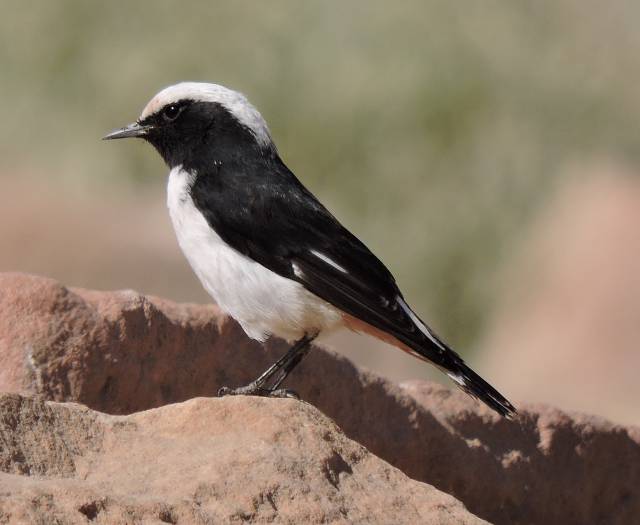
Mourning Wheatear in Jordan at Petra on 16 Oct.
On Monday I chose to go to Fresh Water Lake South as Akhna Dam is losing it’s attraction for birds. At the lake a handful of Greater Flamingos arrived and a Great White Egret was present. The Little Crake was located once more and drake Wigeon and Gadwall were present once more. The Spotted Redshanks continued their stay and several Kingfishers chased each other. Commoner waders were present, but there wasn’t much to get excited about.
On the 14th we flew to Jordan for a short break arriving in the late evening. As we passed Akhna Dam on the way to the airport an Osprey was perched on a telegraph pole next to the Turkish observation post. On the 15th at Mount Nebo, a Yellow-vented Bulbul and Spotted Flycatcher* were present with the ubiquitous Palm Doves. As we continued to Karak and the castle, at Al Haydan, I saw a Southern Grey Shrike on wires and a Red-rumped Swallow above me. On ward to Wadi Al Mugib and the dam where another Yellow-vented Bulbul posed and a Pale Crag Martin (Rock Martin) hawked above us. A Red-backed Shrike was seen and as we continued up the valley, 3 Blackstarts chased each other. Approaching Karak, 2 Tristram’s Grackles passed in front of the car and at Karak, 5 Alpine Swifts and more Pale Crag Martins were visible. Walking around the ruins, several Sardinian Warblers were heard and as I looked above a Lesser Spotted Eagle headed south west and a Long-legged Buzzard hovered over the hillside. Typically I found 3 Blue Rock Thrushes* around the ruins and as we departed for a lunch stop my attention was caught by a strange call that I didn’t recognise immediately. Realising that the birds were no ordinary House Sparrow, I got onto 3 of them perched on the castle walls, proving to be Rock Sparrows*. On route from Karak to Petra along the King’s and Desert Highways where many Mourning Wheatears and a Northern Wheatear were seen we stopped at Jerusalem Rest House near the Hisa Highway intersection where a Mourning Wheatear* fed on flies attracted to some rubbish bags (who said fly tipping isn’t useful)? Prior to this near the intersection a bird was in flight across the desert which initially lucked like a goose or duck, with long neck and brown colouration, I was delighted to see a McQueen’s Bustard. 2 Tristram’s Grackle’s were also near the rest house with a couple of White Wagtails nearby. We continued to Petra passing Ash Shawback where a Long-legged Buzzard was over the road. In Petra near the hotel another Yellow-vented Bulbul was heard and that was it for the day before a good Bedouin meal and an evening candlelight walk through the Siq to the Treasury (who said romance is dead in the Easterbrook household)?
On the 16th was the guided visit to Petra but before this at first light, I walked around the town, noting more Yellow-vented Bulbuls, Palm Doves, a couple of Greenfinches and a female Common Redstart. During the visit around Petra, it gave me the opportunity to get a very close picture of a Mourning Wheatear*, with about 6 being seen and a Blackstart* perched in a 500 year old pistachio tree above me. 3 Desert Larks* were seen and a noisy flock of Tristram’s Grackles. Yellow-vented Bulbuls were numerous, however, last time I visited, some 16 years ago, I saw good numbers of Sinai Rosefinches later in the month. None were seen during this visit, assuming that I was a week or two early to connect with their seasonal movements. As we left Petra a Spotted Flycatcher was near the visitor centre, which we couldn’t visit as King Abdullah was officially opening it and with guards and police aplenty there was no way a scruffy pair of Brit tourists with sunburn were getting anywhere near. Driving back through Ash Shawback again, the Long-legged Buzzard was in the same place and I’d stop counting Mourning Wheatears. At Hisa once more a flock of 6 Brown-necked Ravens was a surprise. Along the highway Barn Swallows were seen and as we neared Amman a Jay flew across the road.
On the 17th we returned home and the last bird I saw was a Common Mynah at the airport. I wondered if this was range expansion for this destructive, intrusive species but it was confirmed by OSME that they are indeed in Jordan now with the airport being one of the two locations. A particularly nuisance species (as AOS members will justify to regarding their behaviour on Ascension Island), there seems to be way of stopping their spread.
Arriving home early and having withdrawal symptoms, I headed for Fresh Water Lake South in the afternoon to catch up. Little had changed with Flamingos numbering 10, although a Red-footed Falcon passed overhead and 2 Black-winged Stilts were present. 2 Redshanks and 2 Spotted Redshanks were quite vocal with several Dunlins and 2 Temminck’s Stints making appearances. As I scanned I found a Little Crake again and a male Wigeon and Gadwall were also present. A Great White Egret flew in to join the Cattle Egrets.
On the 18th I was leading the KUSKOR (Turkish, conservation group) on a short tour of the southern wetlands in the east. First stop Larnaca Sewage Works where a drake Common Pochard was present – not something to get excited about you might say – but a fairly scarce winter visitor in the south of the island. An immature Whiskered Tern was still present along with 2 Shelducks and 2 Black-winged Stilts. 4 Ruffs were around the lagoon edges and on wires a lone European Beeater. 86 Greater Flamingo were on the lagoons and in the area a male Marsh Harrier and Long-legged Buzzard. A couple of immature Red-backed Shrikes were also on telegraph wires and in the airport fields 5 Skylarks were new wintering arrivals. In the fields at Pervolia, good numbers of Yellow Wagtails and Red-throated Pipits were easily flushed. With 5 types of Blue feeding in the Alphalfa and a Banded Argiope spider being photographed, the group needed to refocus. On the way to Akhna Dam, Oroklini was fairly disappointing with only a Common Snipe being of note amongst the numerous Spur-winged Plovers. At Dhekelia Fire Station the group was impressed by the Stone Curlew roost numbering c60. Another Whiskered Tern was a Akhna Dam with a couple of Redshanks and a Greenshank but the highlight was a pair of fishing Ospreys, which put on a great display.
On Sunday the 19th, I had arranged to guide a visiting UK birder, Neville Weston, picking him up at 0730 in Protaras. In the morning the whether was atrocious (rain, what’s happening). The rain didn’t help in the hunt for a Cyprus Warbler and Blue Rock Thrush, which were both a disaster. We did however manage a couple of lifers, connecting with 3 Cyprus Wheatears and many Chukar. An adult Audouin’s Gull flew past the cape with 2 Yellow-legged Gulls and newly arrived Robins were very active. At Ayia Napa Sewage Works, a few immature Red-backed Shrikes were still present and driving towards the football pitches an female Northern Wheatear and the first Black Redstart of the winter was seen. Continuing to Ayia Thekla and lifer number 3, 5 Greater Sand Plovers with Kentish Plovers for comparison was closely followed by number 4 – a flock of Spanish Sparrows with several well marked males, making ID easy. The only Common Sandpiper of the day was also seen on the coast. At Dhekelia Fire Station the Stone Curlew roost was well received and at the Power Station 8 (including 1 immature) Mediterranean Shags were seen.
Next stop Oroklini for the next lifer with 80 or so Spur-winged Plovers being seen at very close range. A surprise was a calling and then seen in flight Penduline Tit. At Larnaca Sewage Works the immature Whiskered Tern, Shelduck and Common Pochard were still present and were joined by my first, winter plumaged, Black-necked Grebe of the winter. Black-headed Gulls had increased to 13 and the 2 Black-winged Stilts were also seen. In a newly flooded area next to the desalination plant, good numbers of Ringed Plovers, Little Stints and Dunlins were feeding with 2 Ruffs also alighting and flying high north. At the salt lake north side, the only Marsh Harrier, a female was seen as was a fleeting glimpse of a Cetti’s Warbler. Akhna Dam was fairly quiet where only a Kingfisher was added to the day list. Another Red-backed Shrike was at Vrysoulles as we passed on the way to Famagusta. Arriving at Fresh Water Lake South at about 1600 we stayed until 1800 although it was a lot quieter than it has been. Searching produced a Temminck’s Stint, 2 Spotted Redshanks and a pair of Green Sandpipers. A Great White Egret flew in and amongst the reeds 2 Water Rails and the final lifer of the day, an immature Little Crake was seen. A Red-footed Falcon passed overhead and at dusk, a flock of 60 or so Starlings and 2 Glossy Ibises arrived to roost as an adult Night Heron woke up and perched in the open. With the addition of 3 late birds it took the day total to a respectable 70, considering the poor start due to inclement weather conditions.
Highlights of the Week: A trip to Jordan refreshing a few species and a first Penduline Tit and Black Redstart of the winter.
Other Interesting Sightings: Another Plain Tiger butterfly at Akhna Dam whilst leading the KUSKOR group on 18th.
If you are planning a visit or require more info please feel free to contact me at: birder639@yahoo.com
Mark Easterbrook
CommentsSPTA West
I have missed 2 months! I spent August in Canada and the USA. September passed in a blur when I hosted a journalist writing an article for Bird Watching magazine about Wiltshire plus a ringing course on the Isle of Wight. This month I have had the opportunity to get out. On 2 Oct a Barred Warbler was ringed on Westdown (by my trainer) as it was only the 2nd record for Wiltshire. I was allowed to look on queuing up behind four 'A' ringers. This week I have seen 1 House Martin and 4 Swallows as well as 76 Golden Plover. We therefore have the last of the summer migrants departing and the winter visitors arriving. I was having to provide an update for the Imber Conservation Group and I have recorded 96 birds on the West this year. This is something of a surprise but when I analyse the results it should be standard for most years. There are still quite a few Chiffchaffs about though at the beginning of the month there were no Stone Curlews around (they had been congregating near Stonehenge). I have seen no Great Bustards on the West however I can report that all birds released this year are still alive and doing well. Birds have commuted to France, Holland, Suffolk and Somerset before returning to the area. I also did not find any of Wiltshire's Montague's Harriers hunting on the West but they had occasionally been seen. This was the last year of the summer fieldwork by our PhD student on Whinchats. Next year she has to write up her results. Currently data suggests that the Plain has the highest density in UK. There is more armour about on the Plain and thus sometimes areas are out of bounds. With such a large area there is always a grid square to survey. Birds are forming large flocks and hopefully will be easier to see now that the leaves are turning. Meadow Pipits and Skylarks are still calling in numbers and of course corvids are plenty. Even Ravens are to be found about the place; I saw 2 at Copehill Down yesterday. Tit flocks are forming though I have only seen Goldcrest with them. Other large flocks of Goldcrest and Linnet are moving around. Every trip out this last week I have seen at least 1 Jay; I cannot remember when I have seen so many Jays. This year has been good for owls and raptors with plenty of food. Roughly 2 out of 3 Barn Owl pairs have had a second brood that fledged though Little Owl remains on the decline. I am now looking forward to seeing our winter visitors.
CommentsCyprus Weekly
Birding Highlights for the Week Ending 12 Oct 14
European Nightjar in day roost at Akhna Dam on 8 & 9 Oct

A late finish at work meant that I could only get to Akhna Dam. It was very quiet with only a Greenshank and Snipe being present on the water’s edge with 3 Little Ringed Plovers on the grass adjacent. A Chiffchaff was amongst the Willow Warblers and 3 Common Redstarts, 2 cracking males. As I drove around 2 immature Red-backed Shrikes, Masked Shrikes and a pair of Spotted Flycatchers were obvious. On driving over the dam wall on the way home a male Red-footed Falcon flew over me which was the highlight of the day. As I drove through Vrysoulles, the local village at least 9 European Beeaters were on the telegraph wires. With passage coming to an end their numbers are steadily decreasing as the month moves on.
On Tuesday I managed to visit both wetlands with the highlights in Famagusta being a pair of Spoonbills, a Spotted Redshank and a lone Temminck’s Stint. I eventually found a Curlew Sandpiper with 6 Dunlins and a solitary immature Black-winged Stilt appeared from behind the vegetation. 3 Wood Sandpipers were joined by a Green Sandpiper and in the eucalyptus trees, at least 3 Spotted Flycatchers were calling and very active. A female Marsh Harrier was present and Greater Flamingos numbered 18. On the station football pitch, 52 White Wagtails were joined by a single Red-throated Pipit, sporting residual breeding plumage. A male Red-footed Falcon and 8 European Beeaters flew over the house prior to departing for Akhna Dam. As I arrived at Akhna, 2 immature Red-backed Shrikes and a Northern Wheatear sat on the wires and a male Common Redstart flitted away amongst the tamarisks. The first Stonechat of the winter was present as I noted it was a female. The dam itself was very quiet with 5 Ruffs, a Glossy Ibis and a Greenshank being the only birds of any note.
On Wednesday I visited Akhna Dam briefly, where a Curlew Sandpiper and a Greenshank were the highlights on the mud. As I drove around I flushed a Quail and seeing where it landed I attempted a photograph. As I moved closer, typically it flushed, as I followed it my eyes were drawn to a shape on a branch. A European Nightjar* in a day roost – an amazing stroke of luck! I positioned for a photograph and got some very close shots, never a bird I thought I’d get to photograph in Cyprus. As I drove on further, several male Common Redstarts moved in the tamarisks with Willow Warblers and a single immature Masked Shrike. A dark shape caught my eye and I was caught out briefly. I first thought it was Drongo or Black Flycatcher type, anyway another closer inspection and some photos revealed a melanistic juvenile Red-backed Shrike* - very unusual indeed, I’ve never seen one before in the 2000 or so previous Red-backs! Several Whinchats and a female Stonechat were also in the area along with my first Fan-tailed Warblers of the month and my first male Spanish Sparrow for some months. As I passed Avgorou on the way home 4 Jackdaws mobbed an adult Long-legged Buzzard.
In the afternoon some shopping in the north allowed me to visit the Fresh Water Lake in Famagusta. 17 Greater Flamingos continued their stay with the usual Herons, but 11 Night Herons (8 adults / 2 1CY and 1 2CY), was a good count. A single Curlew Sandpiper was amongst the Dunlins and 2 Spotted Redshanks remain at the site. Kingfishers were vocal with 2 being seen and I picked out a female Garganey amongst the many Teal. The drake Wigeon was typically elusive but seen briefly and once more all was flushed by a female Marsh Harrier. An immature Masked Shrike rested on a reed and at the base a Sedge Warbler caught insects. As I scanned the base of the vegetations, I firstly found an immature Little Crake closely followed by its larger cousin an immature Spotted Crake. With the light failing 7 Ruffs arrived and 10 Wood Sandpipers gathered for the roost.
Following a bit of a hectic day at work I only managed to get to Akhna Dam for an hour or so. A Long-legged Buzzard soared above me as I arrived. The Greenshank and Redshank were still present and were joined by a lone Glossy Ibis with the signs that it’s been shot with a damaged leg. A female Redstart called and darted through the undergrowth and the melanistic Red-backed Shrike was still knocking around with several typical juveniles and 2 Masked Shrikes. Remarkably the Nightjar was on the same perch, more in the open and allowed for some better full frame shots. As I left the site 19 European Beeaters and 2 Stonechats (a pair), were sat on wires above me and the Little Owl had returned to its favoured roost.
I had arranged to meet Terry Clark a UK birder from Cheltenham briefly on Fri prior to Octoberfest in the Mess and an all day Saturday visit to a few sites. At Akhna Dam, 5 Redstarts and 5 immature Red-backed Shrike were present. Furthermore, a couple of Whinchats remained and 2 immature Masked Shirkes. Perhaps the highlight was close views of an Osprey and a male Marsh Harrier. Waders were in short supply with only a Snipe, Greenshank and 4 Little Ringed Plovers being present and a Kingfisher put in a solid performance. A female Blackcap was a surprise before I headed home to go to the Mess Octoberfest as “Gertrude the buxom serving wench” – Photo on FaceBook for those of you who can access it.
I met Terry at 0900 at the Akhha Dam car park and he drove to the Larnaca area – not wise for me to drive, as I was still feeling the effects of “Gertrude” – enough said! Anyway we arrived at the Larnaca Airport Fields and found an Isabelline Wheatear and several Red-throated Pipits calling overhead. A male Marsh Harrier quartered the fields and a couple of Spectacled Warblers performed well for the camera. The first Skylarks of the winter was seen, but by far the biggest highlight was a rather late Lesser Grey Shrike, which obligingly sat still for Terry’s shutter. Spiro’s beach had 15 Kentish Plovers and a Dunlin running around on it and as we approached the sewage works a female Black Francolin flushed and a Yellow-legged Gull was sat on the lagoon edge. 77 Flamingos were on the sewage works lagoons and the over summering Shelduck had been joined by another. A juvenile Whiskered Tern was a bonus and 3 Black-headed Gulls were the first for the site this winter. We proceeded to Pervolia where after a short walk down a strip between the crops, hundreds of Yellow Wagtails and Red-throated Pipits flushed. A few Greater Short-toed Larks called and landed in the crops and were then undetectable and another Skylark called as it alighted. Calandra Larks are beginning to flock with 19 being present in a calling flock. As we made our way to the border and passed Dhekelia Fire Station, 5 Stone Curlews were seen from the road.
After a brief stop at the house for a cuppa, we made our way over the north via a windscreen tour of the Famagusta Walled City. We arrived at the Fresh Water Lake South at about 1600 and left at about 1800. During the visit 2 Great White Egrets and a 1st calendar year Night Heron were seen along with 5 Kingfishers and a good selection of waders. Spotted Redshanks numbered 2 with several Redshanks, Wood Sandpipers, a single Green Sandpipers, some Ruffs and 4 Black-winged Stilts. Careful scanning of the reeds produced a Spotted and Little Crake and Greater Flamingos were steady at 19. Of the wildfowl 2 Pintails were present and the biggest surprise was the first Gadwall of the winter – a male. A Temminck’s Stint was found with the Little Stints and Spur-winged Plovers were numerous.
On the 12th I visited Akhna Dam in the afternoon where the melanistic Red-backed Shrike* continued its stay and 2 Ospreys were present. The Greenshank and a single Ruff were unremarkable; however, 2 Curlew Sandpipers were noteworthy. An immature Masked Shrike was getting late in the season but there wasn’t much else of interest. I drove around the back of camp where 2 European Beeaters and a Spotted Flycatcher were sat on wires. A Long-legged Buzzard sat on a nearby cliff edge and Stonechats and a single Red-backed Shrike with a Spectcled Warbler and 2 nearby Willow Warblers concluded an interesting couple of days.
Highlights of the Week: Not surprisingly, as ever, anywhere in the world, finding and photographing any day roosting Nightjar is always a great moment.
Other Interesting Sightings: A Plain Tiger butterfly at Larnaca Sewage Works on 11th and a Striped Necked or Balkan Terrapin* was at Akhna Dam on 10th.
If you are planning a visit or require more info please feel free to contact me at: birder639@yahoo.com
Mark Easterbrook
CommentsCyprus Weekly
Birding Highlights for the Week Ending 5 Oct 14
Blue Rock Thrush – Cape Greco Army Camp Cliffs 4 Oct 14

On Monday, I had to visit Troodos on an Ops visit and consequently caught up with the mountain sub-species. As I left the house I could hear and see European Beeaters and 5 Honey Buzzards were above me that had obviously roosted the night nearby and were continuing their migration and at Zygi on the motorway a Long-legged Buzzard was seen. Of interest was 3 Wood Warblers at Giant Juniper Picnic Site. Not common in the autumn, it is thought that many rest in the Troodos Mountains and then carry on their migration without stopping in the lowlands very much – an interesting sighting. A good number of Cyprus Wheatears* were still present in the Troodos range and a couple of Crossbills perched briefly in a Black Pine. Behind the toilet block in Troodos Square, a male Common Redstart appeared briefly and a Tree Pipit was heard overhead calling as it went. On my way home a brief stop at Trimiklini Dam revealed 3 Little Grebes, a Coot, 4 Moorhen and 2 Green Sandpipers flushed. Oroklini held a Kingfisher and the usual commoner small waders with a few Sand Martins still passing through. The highlight at Akhna Dam was an Osprey, 2 Greenshanks and a Curlew Sandpiper, whilst 3 Whiskered Terns remained from the previous week. As I left I saw a single juvenile Red-backed and Masked Shrike, which are coming to the end of their migration periods.
On Tuesday, I took an old friend and OC, Eric Doughty to Fresh Water Lake South in the north. Still probably the best wetland on the island at present, it produced some good birds. A single Glossy Ibis was a surprise and a couple or Marsh Harriers flushed the reduced numbers of waders present. They included 3 Spotted Redshanks, a Temminck;’s Stint and several common migrants. 2 Common Kingfishers were present and the female Pied Kingfisher was spotted by Eric which perched briefly before doing its usual vanishing act once more. At least 4 Night Herons eventually showed themselves and as I scanned I found a Spotted Crake – my first for the year and another visiting birder found a Water Rail close by. As I continued to scan, I found another Spotted Crake (like number 10 busses), which was a new bird for Eric and well received by the other 2 UK birders. 2 Snipe and a Ruff flew in before dusk and Greater Flamingos numbered 9.
Wednesday consisted of a quick trip to Akhna Dam where the highlights were 3 Whiskered Terns, an Osprey and a Wood Sandpiper. In a fairly dull affair, 5 immature Red-backed Shrikes were also present. A lunch in the Mess on Thursday put paid to any birding and on Friday I got out in the afternoon and visited Fresh Water Lake South in Famagusta. 10 Flamingos were still present with 2 Whiskered Terns with many of the waders that were present earlier in the week but a Great White Egret was a good addition to the site. I scanned and found an immature Little Crake closely followed by a Water Rail once more. With not much else doing and the month list beginning to take shape, I returned home.
On Saturday with Deb working, I made for the Cape Greco area via Akhna Dam where an Osprey was resting on a dead snag in the water. A Greenshank and Snipe were also present. As I drove through Freneros at least 15 European Beeaters were on telegraph wires and at Liopetri, A late Lesser Grey Shirke perched and a Black Francolin flushed from the roadside. Ayia Thekla held a Little Egret, Kingfisher, 5 Kentish Plovers and a lone Greater Sand Plover whilst at Kermia Beach a lone Redshank fed and an immature Red-backed Shrike and Cetti’s Warbler were in the bushes.
At Cape Greco Pines, a female Red-footed Falcon perched on the wires and a Purple Heron flushed from a pine, which was unexpected. A Willow Warbler was busy and I then noticed the first female Stonechat of the winter. As is the norm, as Whinchats complete their passage and reduce, the Stonechats begin to arrive for the winter. I carried onto the picnic site passing several Chukars and 2 Cyprus Wheatears. I saw my first male Blue Rock Thrush of the winter and soon found 2 singing male Cyprus Warblers. I drove down onto the Cape proper and saw a Whinchat perched on a bush, another Cyprus Wheatear on the wires and a number of Spectacled Warblers. Under the Army Camp, 2 male Blue Rock Thrushes* sang to the left and under the cliffs another 3 males chased each other and sang – obviously a bit of an influx of them today. Another Cyprus Wheatear was obvious but it took a bit of time to dig out the skulking Lesser Whitethroat. A Spotted Flycatcher and 2 more Cyprus Wheatears concluded the search as I left the area for the sewage works. Arriving at Ayia Napa Sewage Works, I was greeted by a pair of Stonechats and a European Beeater. 22 Little Grebes were on the lagoons along with a male Grey Wagtail. 2 Spotted Flycatchers were in the bushes with an immature Red-backed and Masked Shrike. As I searched the area, at least 7 Lesser Whitethroats, a late female Eastern Orphean Warbler and a scarce for autumn Garden Warbler were present and very active. The last bird of note I saw in the area before departing was a female Common Redstart.
On Sunday afternoon I visited Akhna Dam where 5 Curlew Sandpipers, 4 Dunlins, 4 Little Stints, a Greenshank and a lone Ruff were present. A couple of immature Red-backed Shrikes and a Masked were evident as was a Spotted Flycatcher. An immature Whiskered Tern appeared from nowhere and as I was leaving I saw a nice male Common Redstart. I continued to Fresh Water Lake South to conclude the week where I immediately saw a Great White Egret and 15 Greater Flamingos. 16 Grey Herons were present, with 4 Snipe and 7 Wood Sandpipers. A single Green Sandpiper eventually gave itself up and Common Redshanks outnumbered the 2 remaining Spotted Redshanks. The Water Rail was seen again and the female Pintail was still present. I finally found a drake Wigeon and above me Sand Martins, European Beeaters and Swallows continued to pass. A male Peregrine flushed everything on a flyby and this flushed an immature Whiskered Tern. The Great White Egret roosted with c250 Cattle Egrets and c300 Swallows also roosted in the reeds.
Highlights of the Week: Another Osprey at Akhna Dam and a couple of Spotted Crakes at Fresh Water Lake South on the last day of September took the month total to 145 and the year list to 257 (with one pending). A late Eastern Orphean Warbler was unexpected and the Stonechats were quite an early record.
If you are planning a visit or require more info please feel free to contact me at: birder639@yahoo.com
Mark Easterbrook
CommentsCyprus Weekly
Birding Highlights for the Week Ending 28 Sep 14
Osprey at Akhna Dam

With Fresh Water Lake North appearing to be the best wetland site on the island at the moment and being the closest, I headed there on Monday evening. As I arrived there was a swirl of activity above me with c50 European Beeaters, Sand Martins, Barn Swallows and 1 Red-rumped Swallow. A Marsh Harrier was also being mobbed by a couple of Hooded Crows. As I scanned the water the Avocet and Marsh Sandpiper were still present and a Spotted Redshank had reappeared. A Great White Egret was a good find and next to it an adult Spoonbill was my first for the month and indeed sometime. A few Curlew Sandpipers were dotted around with Little Stints, Dunlins, Wood Sandpipers and Common Redshanks also being obvious. A couple of Common Kingfishers darted about and I then heard the familiar piping of a Pied Kingfisher as the female that’s been present for sometime flew from the South to the North Lake at about 1810. 8 Flamingos remained in situ and the Black-winged Stilts numbered 4. A few Turtle Doves flew into a bush and flushed a Night Heron as a Ruff came into view with a couple of Snipe. At home the Little Owl continued to call in the night.
On Tuesday afternoon having not visited Ayia Napa Sewage Works for sometime I drove down there arriving at about 1500 via the football pitches where my first Lesser Grey Shrike for a week – an immature was on the fence with 2 immature Red-backs. I proceeded to the sewage works noting a Common Sandpiper and 6 Shovelers were present. As I made my way around the scrub at least 6 Lesser Whitethroats, 2 Blackcaps and a few Spectacled Warblers were seen. On the tracks 2 Northern Wheatear males were noted and 2 male Masked Shrikes flushed as I approached. 2 Whinchats were perched up but their passage is coming to an end and Stonechats will soon be arriving at their wintering grounds. A Spotted Flycatcher did what it’s supposed to do and a Wryneck flew from a bush and perched briefly before disappearing once more. A large raptor flew across me and was clearly a Steppe Buzzard whilst in the distance a male Hobby drifted out to sea. As I walked the tracks a large pale raptor rose from the scrub and flew over my head. With very pale features, barring on the underparts and a hint of a brown throat, coupled with it’s size and plain brownish back with some white spotting across the coverts, it was a light phase Short-toed Eagle – a great find! As I walked to the car, 4 Spur-winged Plovers were on the settling ponds and a call alerted me to the presence of a pair of Grey Wagtails, which were new of the site. European Beeaters continued to pass overhead as I headed to Cape Greco. At the Cape it was fairly quiet, although a male Cyprus Wheatear, a couple of Spectacled Warblers, a male Sardinian Warbler and several Crested Larks were present whilst Sand Martins and Barn Swallows headed out to sea.
On Wednesday afternoon I took a visiting UK birder out – Chris Godding. We visited the Ayia Napa Sewage Works area first, which produced a couple of Lesser Whitethroats, Eastern Olivaceous Warblers, a Hobby and a Honey Buzzard as the highlights. Stopping at he football pitches produced 2 Lesser Grey and 2 Red-backed Shrikes. We then went via Ayia Thekla, where 5 Greater Sand Plovers and a few Kentish Plovers were present to Akhna Dam. A Roller flew off as we arrived and an Osprey passed overhead heading to the coast. Akhna Dam was fairly quiet, although a few waders were present with a Whiskered Tern. A Peregrine was flying high in the distance but with not much else happening, we visited the North and Fresh Water Lake South. With a few good birds seen we proceeded to the North and finished the day at Fresh Water Lake South – Famagusta, which is currently probably the best wetland site on the island. The trip was very productive and didn’t disappoint. The Spoonbill was still present with 24 Greater Flamingos. Squacco, Night and Grey Herons were present with a good count of 24 Little Egrets and Cattle Egrets coming to roost later. The waders were well represented with Wood, Marsh and Curlew Sandpipers feeding actively. Spotted and Common Redshanks were joined by feeding Ruffs and a lone Avocet continued its stay. Careful scanning produced a couple of Snipe and a juvenile Little Crake. We managed to pick out a single female Garganey and Pintail amongst the other wildfowl. A female Marsh Harrier flushed everything as a couple of Honey Buzzards passed behind us with one resting in a eucalyptus briefly. Hundreds of European Beeaters were feeding above us and as we watched a Hobby and 5 Red-foooted Falcons were above us and heading South. Perhaps the highlight of the visit was a hunting Peregrine and a Black Kite which drifted past, showing well towards dusk and just before we left. I thank Chris for his company for the 3rd year running and being a week later this year some good birds were added to his Cyprus list as we saw 66 species in the day – which isn’t a bad count given the windy conditions induced by the pending Coptic storm that’s due.
Wine tasting in the Mess on Friday ensured that no birding took place. An early rise on Saturday and showing a photographer around the Cape Greco area. It was really quiet with only Spectacled Warblers, 5 Grey Herons and 2 Yellow-legged Gulls offshore and a male Cyprus Wheatear hanging on. At the sewage works it was quite also with a female Northern Wheatear, a few Lesser Whitethroats and Long-legged Buzzard being the highlights. At Ayia Napa Football Pitches an immature Lesser Grey Shrike, Turtle Dove and Roller posed for the camera but there wasn’t much happening. We proceeded to Ayia Thekla where as usual 6 Greater Sand Plovers revealed themselves amongst the Kentish Plovers whilst a Kingfisher and Common Sandpiper moved along the rocky coast. I returned home via Akhna Dam where as Temminck’s Stint and Whiskered Tern were present. I eventually found a Curlew Sandpiper and 4 immature Red-backed Shrikes and a male Black Francolin showed themselves as I left the site.
On Sunday, as I left for the Larnaca area an adult Long-legged Buzzard was over the house and as I passed Akhna Dam a ringtail Montague’s Harrier passed over the road. Arriving at a windy Larnaca Sewage Works there was little of interest although the Shelduck continued its over-summering and 5 Whiskered Terns and a White-winged Black Tern were on the lagoons. A female Marsh Harrier flushed the birds in the field and this was fortuitous as it flushed a Greater Short-toed Lark which called and then settled next to a Crested Lark where I got the scope on it. 14 Greater Flamingos were on Larnaca Salt Lake which had water present after a hefty thunder storm on Saturday. At Oroklini Marsh, a Black Kite and 5 Red-rumped Swallows were overhead but the lagoons were fairly empty. I didn’t do much better at Akhna Dam which was also quiet, although a Whiskered Tern and 2 Curlew Sandpipers were evident. As I drove around the fields at the top of the dam a Honey Buzzard was resting on the ground but alighted before I could get any decent photos.
In the evening I visited Fresh Water Lake South in Famagusta. It’s a fantastic little wetland and always worth a visit. The Spoonbill and Avocet were still present and at least 50 European Beeaters passed overhead. Greater Flamingos numbered 23, 5 Red-rumped Swallows were overhead and the Marsh Sandpiper was still on the mud. Spotted Redshanks had increased to 4 and then a juvenile Bonell’s Eagle flew through mobbed by Hooded Crows which flushed everything. Things resettled revealing a Temminck’s Stint and a Green Sandpiper. A good number of raptors appeared over the woods which included at least 2 Black Kites, 7 Marsh Harriers (2 males) and 2 male Red-footed Falcons flew through the area which made the 3 Whiskered Terns flush and rise high above. That concluded an eventful week which produced some good migration and birds.
Highlights of the Week: A Spoonbill was a good find and the re-sighting of the Pied Kingfisher was notable. Short-toed Eagle is a scarce raptor on Cyprus and it’s always good to see one.
If you are planning a visit or require more info please feel free to contact me at: birder639@yahoo.com
Mark Easterbrook
Comments

Follow us:

