 Army Ornithological Society
 Blog
Cyprus Weekly
Birding Highlights for the Week Ending 14 Apr
Great Snipe at Akhna Dam on 10 Apr.

* indicates that a photo of the species is included please visit Flickr site to view.
It’s Monday and never a good day for birding. However, I did make it to Paralimini Lake and although plenty of birds were present, nothing extraordinary was seen. 3 Spotted Redshanks* and a Woodchat Shrike were probably the highlights with a very tired looking male Whinchat* posing for the camera. The earlier reported female Caspian Plover appeared to have moved on but it could have been hunkering down in the vast expanse of the now, in many places lake. There were a good number of Kestrels present – at least 15, although suspected that they were Lessers, at distance and with all being females it was impossible to discriminate.
Tuesday and a quick visit to Cape Greco to look for the reported Southern Grey Shrike was unproductive. Paralimini Lake on the return was also very quiet although a ringtail Montague’s Harrier was seen close by. At Akhna Dam, 28 Wood Sandpipers, 2 Common Sandpipers and 4 Little Ringed Plovers was all that was present. As I returned home driving across the agricultural land to the south of the dam, I encountered another Yellow Wagtail “fest”. Amongst the 2 – 300 birds present were at least 200 Blue-headed (flava), 3 Black-headed (feldegg), 1 supercilliaris (feldegg x flava), 1 xanthrophys (feldegg x lutea), 2 Grey-headed (thunbergi), 2 Syke’s (beema) and at least 3 dombrowski (feldegg x flava / feldegg x beema) – which was a new one for Cyprus for me. I spent at least half an hour grilling them which I sadly really enjoy doing. It’s amazing that in the last 2 weeks the majority were feldeggs and now they’re flavas. It’s obvious that each form has a peak passage period, so only lutea to find – which will be easier said than done.
Whilst shopping for some bread in the North I visited the Fresh Water Lake South, Glossy Ibises were present in the Cattle Egret colony and look set to attempt breeding. Also present was a Great White Egret, 2 Slender-billed Gulls, 3 Black-headed Gulls (getting late) and 6 Yellow-legged Gulls but not much else. I was scanning the gulls at Clapsides Beach when I received a text message confirming that the Southern Grey Shrike was still at Cape Greco. We headed back over the border immediately. When we arrived at Cape Greco, I walked the area and suddenly a black and white bird sat on top of a bush, long enough for me to get a view of it in the bins, it then flew low and fast as Shrikes do for a long distance – not to be seen again in typical Shrike fasion. In any event with little white in the wings and being smaller and more slender than a Great Grey Shrike there is no doubt of its identity. Others apparently have pictures of the bird confirming that it’s of the race aucheri – a Middle East race, not known for migration and only the second record for Cyprus – so a Cyprus “tick” for me. At the 3rd attempt, this is an elusive bird, so well done for those who firstly found it (Jonannes & Thiejs) and secondly managed to photograph it.
With no significant bird news, I thought I’d give Akhna Dam a whirl. With a target species in mind and with this being the peak migration period for them, I set off to find a Great Snipe. I have only previously seen 2, both at Akhna Dam, 1 on 18 Apr 1998 and the other on 21 Apr 1999. Despite my worldly travels, it has remained a fairly difficult species to catch up with. The muddy areas to the south of the dam with small pools and dryish ground looked perfect for one the other day, so that’s where I started. 30 Wood Sandpipers* and 2 Green Sandpipers* were present along with 2 Ruff, 12 Black-winged Stilts, 2 Little Ringed Plovers, 4 Spur-winged Plovers and 7 Little Stints. As I drove up the track to depart, I noticed a small pool on my left with some waders. Bins up – Great Snipe* with a Common Snipe – SUPERB. I got a few quick record shots and then inched the car closer, it fed actively and seemed fairly settled and not bothered by the car, the result being some really close pictures of this difficult to find species. Very pleased with myself I went for a walk flushing a male Sparrowhawk and then alerted by a call looked around and saw some Beeaters. When my brain finally engaged, I thought Arabia – they were of course Blue-cheeked Beeaters* and a bird I thought I’d missed this Spring. Although not perching close to me, I did manage a couple of ropey, distant record shots for the gallery. Some say discriminating between those and European on call is not possible – I say that’s rubbish. Blue Cheeked have a shorter, higher pitched call that is less throaty than European and it’s fairly obvious. Before I departed 13 Glossy Ibises did a flyby and it was time for the most enormous pork chop I’ve ever seen in my life, at our local grill. I would love to see the size of the pig that produced the monster! The end of an excellent day and a tot of Cap’n Morgan’s Spicey and all was good in the world with Akhna Dam back in favour and returning from the brink of oblivion.
Friday already and still plenty of migration occurring. However, the North was decidedly average but at Cape Greco I caught up with a male Collared Flycatcher and then showed some visiting birders the Great Snipe which was still present at Akhna Dam
On Saturday morning I’d arranged to meet members of the Cyprus Dragonfly study group that are visiting this end of the island and show them the local sites. I met them at 1000 and headed for Oroklini Marsh. However, prior to this, I had risen early and visited the Larnaca area. Larnaca Airport Fields had a Greater Short-toed Lark and my first Roller of the Spring. Black Francolin males were calling and seen everywhere with at least 5 being seen in the area. At Spiro’s Pool a Squacco Heron and Red-throated Pipet whilst Black-headed Yellow Wagtails appeared to be gathering nesting material. I moved along to Larnaca Airport Pools North which had a good number of waders present. A year tick came with a couple of Curlew Sandpipers – one in breeding plumage, whilst 3 Black-tailed Godwits were also feeding along with numerous Little Stints and Ruffs. 13 Slender-billed Gulls were also present. At Larnaca Salt Lake North, 2 Avocets were amongst the Ruffs, Marsh Sandpipers, Greenshanks and a couple of Spotted Redshanks. 2 resting Little Terns were also new birds for the year and 18 Greater Flamingo juveniles are hanging on. At Oroklini, the pair of Red-crested Pochards remain with a Sedge Warbler and female Montague’s Harrier making an appearance. On the way to Sotira at Freneros another 2 Rollers sat on wires and as we arrived at Sotira Ponds to see the Dark Spreadwing colony, now numbering 1000s, a male Golden Oriole flew over heading north and later a Black Kite did likewise.
On Sunday I met the Dragonfly group at Fresh Water Lake South, in the North. Before meeting them I had gone to Cape Greco early and in the pines saw 2 Wood Warblers, an Eastern Bonelli’s, a female Pied Flycatcher and a Spotted Flycatcher. On the opposite side of the road a male Red-backed Shrike looked resplendent and another was seen nearer the Cape’s tip along with a Whitethroat, Wryneck and a couple of Lesser Whitethroats. As I left the area a Whinchat sat atop a bush and at the Picnic Site, Cyprus Warblers continue to sing and a juvenile was also seen. 3 Ortolan Buntings flushed from the grass and a Purple Heron flew over Konnos Bay.
At the Sewage Works, a male Collared Flycatcher hunted and a couple of Ortolans fed on the floor with a few Lesser Whitethroats. A single Black-winged Stilt on the lagoons looked lonely and the rest of the area held a Masked Shrike, Whinchat, a pair of Cyprus Wheatears and a couple of Blackcaps. I met the Dragonfly group in the North at Fresh Water Lake South and we found a new Damselfly for me with a pair of Blue Eyes* sitting on a reed. A Gull-billed Tern was over the lake and a couple of Squacco Herons flushed, as a pair of Slender-billed Gulls did a flyby. A Cuckoo flew from cover and the Glossy Ibises remain in the Cattle Egret colony. After an enjoyable lunch in Famagusta Square – always a joy, we returned over the border and headed towards the motorway. Under the guise of showing them the way, I said to Deb “since we’re almost in Larnaca, we may as well look for the Red-necked Phalaropes that have been reported”, we did this without look as the birds had been disturbed from Spiro’s Pool. A Stone Curlew stood in the Larnaca Sewage Works hide field with an Isabelline Wheatear, some Spur-winged Plovers with a Spotted Redshank and a couple of Garganeys in the Sewage Works. Knowing the area, I thought I’d check Larnaca Airport Pool North before departing the area. My hunch paid off as the 3 Phalaropes were feeding amongst the many Little Stints and 5 Curlew Sandpipers.
For pictures of birds with a * please click on the following Flickr links:
- Spotted Redshank at Paralimni Lake.
- Whinchat at Paralimni Lake.
- Green Sandpiper at Akhna Dam.
- Green & Wood Sandpiper at Akhna Dam.
- Blue-cheeked Beeaters at Akhna Dam (distant record shot).
Highlight of the Week: Eventually getting an acceptable view of the Southern Grey Shrike was a bonus bird for the year and an addition to the Cyprus list. But finding a Great Snipe is always a highlight.
Other Interesting Finds: Sadly, I have to admit, there’s no items to report, with migration in full swing, I have been preoccupied, however the Blue Eye Damselfly was new for me.
Look Forward: My sister and brother-in-law (4th set of visitors this year) arrive at the end of next week, so with some leave looming and visits to the North, Paphos and Troodos planned anything is possible. As my brother-in-law is a keen butterfly enthusiast, you know where this is going – standby for some butterfly pictures and perhaps I’ll see my remaining Cypriot species.
If you are planning a visit or require more info please feel free to contact me at: birder639@yahoo.com
Mark Easterbrook
CommentsCyprus Weekly
Birding Highlights for the Week Ending 7 Apr
Isabelline (Daurian) Shrike at Cape Greco Pines 6 Apr.
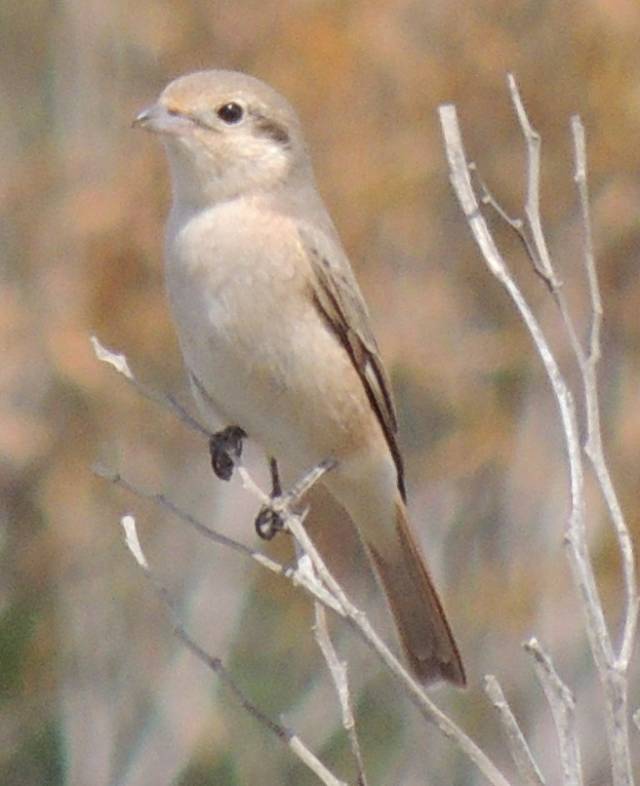
* indicates that a photo of the species is included please visit Flickr site to view.
April already! With bank holiday Monday, a whole day’s birding. With migrants everywhere, it’s difficult to know where to start first. Cape Greco is always a safe option that gives an indication of what’s about. A bit disappointing, with not much moving but the usual Wheatears, a couple of Hoopoes and a Nightingale heard and then one seen. I chance bit of seawatching (this is usually a waste of time), resulted in a couple of Sandwich Terns, Baltic Gulls, Yellow-legged Gulls and then to my amazement a Cyprus “tick” as 4 Yelkouan Shearwaters skipped over the waves – a great start to the month! I returned via Paralimni Lake where a male Lesser Kestrel was resting. In the afternoon we took a picnic lunch to Koprulu Dam in the North. Here c100 Greater Flamingo remained, with numerous wildfowl including 27 Garganey and several drake Pintails. The area was alive with waders with c1500 Ruffs, Greenshanks, Marsh and Wood Sandpipers and good numbers of Black-winged Stilts. At least 17 Glossy Ibises rose from the reeds and Marsh and Pallid Harriers were very active. Before returning home we stopped at Fresh Water Lake South, Famagusta where there were 4 Great White Egrets and 2 Night Herons amongst the many Cattle Egrets.
The 2nd April and my birthday. I took the day off and headed to Cape Greco once more. Again not much doing but Cyprus Warblers and Wheatears remain very vocal and the usual other species were present with at least 5 Tree Pipits flying over calling. At Ayia Napa Sewage Works a lone Common Sandpiper was on the lagoons and in the surrounding area my first Redstart of the year along with a male and female Pied Flycatcher. A male Masked Shrike stood lookout and a Nightingale sang from cover but did not reveal itself. At least 3 Cyprus Wheatears were present but little else. At Paralimini Lake on the way home, 8 Glossy Ibises, a Northern Wheatear and a singing Great Reed Warbler were present. In the afternoon prior to my return to work tomorrow – the Turkish barbers loomed. After a successful visit, lunch in Famagusta before visiting the Fresh Water Lake where the Night Herons had increased to 6. In the evening a visit to the Japanese Restaurant in Ayia Napa. Renowned for the chefs’ antics, the food was excellent and being unaware that Deb had told them it was my birthday, I was given the full very embarrassing treatment – which as you can imagine, I saw the funny side of?
Wednesday, back to work (joy) and the car in the garage for a service following some fairly hefty mileages throughout February and March. So who knows when that’ll be fixed or whether I’ll get out today. With a Hooded Wheatear reported late last night at Cape Greco, the timing could not be worse. Whilst at the garage, I received a text alerting me to the presence of a female Caspian Plover* at Larnaca Sewage Works. With a little “chivvying” – well a lot really, I was soon underway and consequently viewing and photographing the bird some 40 minutes later – RESULT! With a description pending the record shot was essential. Nothing much was in the area apart from some Wheatears and Wagtails so I headed back to Oroklini where I bagged a female Citrine Wagtail for the year and a couple of female Little Crakes for the month.
Thursday and capitalising on some carried over leave - a day off, in an attempt to bag a few more migrants. At Cape Greco I stumbled across 2 Cuckoos and a Redstart whilst at the picnic site a male Eastern Orphean Warbler, female Ortolan Bunting and a Wryneck. Under the Army Camp, I looked at some hirundines and amongst the Swallows and House Martins were 4 Crag Martins. With an Eastern Black-eared Wheatear, Tree Pipits and a Tawny Pipit in the same area things were obviously moving albeit in small numbers. Later at Ayia Napa Sewage Works, the theme continued with another couple of Wheatears representing 4 species and 4 Masked Shrike males and a Woodchat. Nightingales sang around me and another Redstart posed in the open. An Eastern Bonelli’s Warbler was a good find as was another Wryneck. With another being flushed at Paralimni Lake on the way home – it was obviously “Wryneck Day”. A male Spotted Crake in the open at Paralimni was also a welcomed month tick, with a male Pallid Harrier and 4 Glossy Ibises also being present.
Friday and on finishing work a text message from Colin reference an Isabelline Shrike at Cape Greco found by a visiting birder – what it’s like to be retired? I searched the area without luck and so visited the sewage works at Ayia Napa in case the bird had relocated – it hadn’t, so a dip! At the sewage works a good number of Cyprus Wheatears, a Hoopoe, Woodchat, female Eastern Subalpine Wabler and a Wryneck. As I left to look for the Shrike once more a small dove with a dark brown upper chest flew over me a the Marina Hotel – Ayia Napa. I pulled over and searched the trees finding another Wryneck* and then, there it was, although obscured the blue forewing below the grey wing of a Laughing Dove. The birds having been seen regularly in the area for a few years and suspected of breeding are on the way to becoming residents I think. The car then made a strange noise and lost power, I managed to limp back home stalling on the way. When I restarted – all back to normal save for a few splutters, worrying all the same.
It’s Saturday already and a visit to the Karpas Peninsular in the North for a KUSKOR field trip had to be postponed due to issues with the car. Anyway I drove to Akhna Dam It’s the first visti to Akhna in a while – formerly my hotspot, but the site is improving again. A couple of Sedge Warblers, A Great Reed and many Cetti’s along with an Eastern Bonelli’s Warbler kicked things off. My first 2 Squacco Herons of the year were flushed and a Purple Heron also moved out of its roost. Waders are starting to return with Wood and Common Sandpipers, several Little Stints, a Little Ringed Plover a single Ruff. Whilst at Akhna Dam I received a message from 2 visiting birders alerting to the fact that the Isabelline Shrike had been re-found at Cape Greco. I headed off there as quickly as I could to start looking. A couple of Woodchats caused a stir and then I spotted the very pale Shrike* in a bush and then flycatching. I returned through the pine wood seeing a couple of Lesser Whitethroats, Restarts and an Eastern Bonelli’s Warbler and then saw a bright flash of white which eventually enabled me to catch up with a spanking Wood Warbler*. As I left I flushed a Night Heron and headed off to Ayia Napa Sewage Works. Although nothing spectacular, a couple of Buntings, Wheatears and Shrikes were good additions, none the less. On Saturday evening, I visited Paralimni Lake where the highlight was good numbers of varying races of Yellow Wagtails and another female Caspian Plover amongst the masses of Little Ringed and Kentish Plovers.
Sunday morning has arrived and the migrant hunt is back on. The Isabelline (Turkestan) Shrike was still at Cape Greco along with the same or another Wood Warbler. Several Black Redstarts and Wrynecks were present along with some commoner migrants. A chance stop to look at some Gulls and Terns moving across Konnos Bay had Johannes finding 2 Scopoli’s Shearwarters close in, lazily moving west. I managed to see them, a real bonus as many hours sea watching in Cyprus usually results in boredom so a real result and a very good year tick – Thanks Johannes! 2 European Beeaters called above us and appeared to be migrating in the wrong direction but were eventually located high in the clouds. We moved to Paralimini Lake where nothing special happened although a fly over Collared Pratincole was the highlight and the male Spotted Crake was seen again along with a lone Whinchat. Before heading to the Famagusta Wetlands and Koprulu Dam we stopped for a brew at the house. The wetlands were quiet although Greater Flamingos still linger at Gulserin Pond (mostly juveniles), Clapsides beach had a record 10 Audouin’s Gulls and Johannes and Thijs got a Cyprus “tick” with a late Grey Plover.
Koprulu, needed 2 attempts to get there as the car decided not to play the game again. Anyway a brief stop and restart and we arrived eventually at probably the best wetland on the island at the moment was full of birds, at least 30 Glossy Ibises, 2 Purple Herons, 5 Marsh Harriers, a Monty’s, Red-throated Pipits, Great Reed, Reed and Sedge Warblers, a whole host of waders but nothing new since my last visit and a fly over Collared Pratincole. Wildfowl are still much in evidence with 7 Ferruginous Ducks, 17 Pintails and good numbers of Garganey, Shovellers and Teal. On driving home we paused to photograph a Little Owl* in Koprulu village whilst several Kestrels on the wires proved to be Lessers*. We returned home via the Fresh Water Lake South before heading home for a Chilli and a few beers – the end of a cracking day and week.
For pictures of birds with a * please click on the following Flickr links:
- Little Owl at Korprulu.
- Wood Warbler at Cape Greco.
- Lesser Kestrel near Koprulu Dam.
- Eastern Black-eared Wheatear at Ayia Napa Sewage Works.
- Wryneck at The Marina Hotel – Ayia Napa.
Highlight of the Week: A Cyprus “tick” with a 4 Yelkouan Shearwaters at Cape Greco on Monday. Caspian Plovers are always a good bird to see and of course an Isabelline Shrike. I remember finding the 3rd for Cyprus back in 1998 when it was a description species – but no longer required as it’s seen as an annual migrant. Taking the Cyprus list to 290. The rolling year list to (Jun 10 – Jun 10) to 250 and the current year list resides on 206 – so all-in-all a very productive week
Other Interesting Finds: Another Eastern Dappled White at Ayia Napa Sewage Works and my first Lulworth Skipper* and first this year for Cyprus was seen at Konnos Bay, Cape Greco on Saturday 6th.
Look Forward: Migration and the hope of finding a semi rarity or two.
If you are planning a visit or require more info please feel free to contact me at: birder639@yahoo.com
Mark Easterbrook
CommentsCyprus Weekly
Birding Highlights for the Week Ending 31 Mar

Woodchat Shrike at Ayia Napa Sewage Works 29 Mar
* indicates that a photo of the species is included please visit Flickr site to view http://www.flickr.com/photos/birder639/sets.
Now that it’s light enough it allows me a couple of hours birding after work on a Monday. So this Monday it was a visit to Paralimni Lake, where numerous waders are now passing through including, Marsh, Wood and Green Sandpipers along with Redshanks, Greenshanks, Black-winged Stilts, Kentish Plovers and Black-winged Stilts. 3 Great and 5 Little Egrets with a couple of Grey Herons and the usual Cattle Egrets added to the numbers but a Curlew was a surprise. As I moved closer to the reed beds, my first Great Reed Warbler, a Sedge Warbler and a Little Crake were seen and on Sotira Pond at least 18 Garganeys.
On Tuesday I headed for the Cape Greco area which was pretty quiet, except for a couple of Hoopoes, Isabelline Wheatears and at least 2 singing male Cyprus Warblers. Under the army camp at least 2 Cyprus Wheatears are now holding territory. At Ayia Napa Sewage Works it sounded pretty quiet although after a walk around the trees at least 5 Tree Pipits and a Eastern Bonelli’s Warbler called and was fly catching. A male Masked Shrike was good to see and silvia warblers were much in evidence with Lesser Whitethroats, Spectacled and Blackcaps being present. A male Marsh Harrier drifted overhead and 2 Green Sandpipers were on the lagoons as I left. Good numbers of Vagrant Emperors* are still present.
I returned via Paralimini Lake which is now looking like a fantastic site and so it proved to be. A good hour was spent at the site which provided views of 24 Marsh Sandpipers, at least 1200 Ruff, along with Wood and Green Sandpiperes. Numbers of Black-winged Stilts and Spur-winged Plovers are building and a lone Greenshank was also present. An unseasonal Turnstone amongst the many Kentish Plovers was a surprise and patient scanning of the reeds gave views of Sedge Warblers, Lesser Whitethroats, a Cetti’s Warbler and a nice male Little Crake. Some nearby shooting flushed 5 Garganeys and considering 18 were present yesterday, one can guess the fate of the others. I flushed a Purple Heron – the first this year for me and 6 Great Whites and 5 Little Egrets with 4 Cattle Egrets completed the heron bonanza.
Wednesday and a Silver Lunch in the Mess – ‘nuff said! You all know the routine by now. I had a day off on Thursday and once I had managed to surface, I headed off to North and there wasn’t much to shout about. 2 juveniles stood in the sea was a strange sight at Clapsides Beach and at Fresh Water Lake South a Glossy Ibis was in the Cattle Egret breeding colony and a late Heuglin’s Gull was a good record. I also managed to find a migrating 1w Little Gull but then returned home – still with a headache.
Good Friday and off to Cape Greco – migrant hunting stopping on route at Paralimni Lake. A good decision as I found a female Rock Thrush eating insects, a flock of 31 Greater Short-toed Larks were also present. On to Cape Greco and a few migrants were about, the pick being a couple of Cretszchmar’s Buntings and a beautiful male Pallid Harrier – in off the sea. It was obviously Tree Pipit day with numerous birds flying over calling. At Ayia Napa Sewage Works, I photographed a male Ortolan Bunting* and saw couple of Masked Shrikes and a Woodchat Shrike*. I left and saw probably my last Black Redstart of the season. At Paralimni Lake on the way home, no birds to speak of but the colony (the largest in Europe) of Dark Spreadwings* had started to emerge with at least 12 being present. An adult Armenian Gull at Larnaca Sewage Works was a late record as were a couple of 1w Caspians and an adult Baltic Gull. Stopping at Oroklini Marsh on the way home gave views of 2 pairs of Red-crested Pochards, 3 Spotted Redsanks and a couple of female Little Crakes fed in the open. At Dolphin rocks, 2 Med Gulls and at least 80 Slender-billed Gulls were present with the now dwindling flocks of Black-headed Gulls.
On Saturday, I visited Clapsides Beach where 7 Audouin’s Gulls loafed with a Sandwich Tern and a single Grey Plover, which was a good late record. At Fresh Water Lake South the Little Gull was still present with 5 Slender-billed Gulls, resplendent in pink breeding plumage. I visited Paralimni lake at the end of the day to see a female Little Crake and a male Spotted Crake. As I scanned the Yellow Wagtails, the majority being Black-headed, I first saw a Water Pipit and then a Grey-headed Yellow Wagtail (thunbergi).
On Easter Sunday another early morning visit to Cape Greco paid dividends with my first Pied Flycatcher of the year. I had arranged to meet 2 visiting birders who are doing survey work for BirdLife Cyprus, good company and very talented birders. Later at the Ayia Napa Sewage Works, a male Eastern Orphean Warbler, a Ruppel’s Warbler, several Lesser Whitethroats, a Tawny Pipit and 3 species of Wheatear with a male Masked Shrike also showing well. As we walked around, the Dutch birder and the German birder I was with (exceptional young birders), pointed out an Orchid – I looked at it and realised it was a new one for me. When I analysed the photos at home, it was a Bornmueller’s Ophrys (Ophrys bornmuellrii), only right that they found it with a name like that. As I left, 2 Red-rumped Swallows did a flyby. On the track to Ayia Napa Football Pitches, I stopped to photograph a butterfly that caught my attention and indeed it turned out to be a new species for me in the form of an Eastern Dappled White* At the football pitches, another Masked Shrike (female) and a male Black Francolin. A detour to Ayia Thekla provided views of probably the last remaining wintering Greater Sand Plover (columbinus). I stopped at Paralimni Lake as usual and there 3 Black-eared Wheatears, a Northern and a Cyprus gave great views. The Spotted Crake and Little Crake showed once more, this time a male and on the flats 3 Greater Sand Plovers in superb breeding plumage of the race crassirostris. Obviously migrants as the wintering race are colombinus with much smaller bills. We saw the Cyprus endemic Cyprus Grass Snake swimming in Sotira Pond and one of the birders I was with caught a Black Whip Snake* which I of course had my picture taken with. A female Ortolan Bunting rounded off a good day.
For pictures of birds with a * please click on the following Flickr links:
- Ortolan Bunting at Ayia Napa Sewage Works.
- Common Buzzard at Cape Greco.
- Tree Pipit at Ayia Napa Sewage Works.
- Lesser Whitethroat at Ayia Napa Sewage Works.
- Reed Warbler at Larnaca Salt Lake North.
Highlight of the Week: Nothing in particular but some good year ticks although migration remains slow, a mixed number of species is passing but not in volume.
Other Interesting Finds: The Eastern Dappled White butterfly, another new orchid with the total now on 27 species. The emergence of the Dark Spreadwing colony at Sotira Pond and of course the Black Whip Snake were all notable experiences.
Look Forward: More of the same with additional migrating species hopefully – and of course my birthday on the 2nd.
If you are planning a visit or require more info please feel free to contact me at: birder639@yahoo.com
Mark Easterbrook
Comments
SPTA West
A Mediterranean Gull amongst the hundreds
It has been a rather blustery and cold landscape on the Plain. The majority of birds are skulking around deep in any cover and rarely move. I practically stepped on a Pheasant before it moved which made me jump. Even the corvids are bunkering down. The Wheatears are arriving at a steady rate and they have been seen across the area. Incidentally the BTO web site still keeps telling me thay are out of season. A Stone Curlew was seen on the Centre northern road. There are still flocks of Starlings, Fieldfare and Golden Plover. Also seen were Woodcock and Stonechat. This weekend Imber Village was open to the public. The village is dry and the water is not flowing down the main street. Even the ponds to prevent flooding are nearly dry. It is amazing how quickly the water disappears once the rain stops. The bournes are still flowing but have decreased in flow rate. At long last I managed to find a Mediterranean Gull amongst the hundreds of Black-headed and Common Gulls that are found south of the Plain on the A36 valley. There is also a Little Ringed Plover on Langford Lakes which is not too far away from Knook Camp.
CommentsCyprus Weekly
Birding Highlights for the Week Ending 24 Mar

Male Ruppel's Warbler at Cape Greco 19 Mar - I'll try harder next time to get the tail in. * indicates that a photo of the species is included please visit Flickr site to view.
A day’s leave on Monday so a full day out in search of some lingering migrants from the fall on Saturday which I missed due to attendance at the tulip festival. Cape Greco was the obvious choice but it was Green Monday - a Cypriot bank holiday. With hundreds of people usually heading for the National Park it was essential to start early. Why it is called Green Monday I have no idea as judging by the amount of rubbish, drinks cans and other debris left lying around it has little to do with any conservation, ecological or environmental credentials (if they exist) that the Cypriots may hold. Whilst at the Konnos Bay area, I saw a couple of Lesser Whitethroats, an Isabelline Wheatear, Blue Rock Thrush, several Cyprus Warblers, a Ruppel's Warbler and the star of the show a male Masked Shrike. At the Cape’s tip, more Isabellines and 3 Greater Short-toed Larks were present. As I transited from this area to the rubbish tip and sea caves I saw a Woodchat Shrike* and another Ruppels Warbler.
The highlight of the day was seeing 5 species of Wheatear in the area including 3 Deserts* (1 male), 4 Isabelline, a female Finsch’s, 3 Cyprus and a single male Northern with the 6th of the day, a cracking male Eastern Black-eared* being added at Ayia Napa Sewage Works later. Also present were 3 Tawny Pipits, a couple of Ruppel's Warblers and at least 3 Lesser Whitethroats. As I was leaving the area 3 Alpine Swifts stopped briefly to feed at the sea caves.
I returned home for lunch and some admin before driving to the Larnaca area for the afternoon’s migrant hunt. At the sewage works and surrounding areas good numbers of Slender-billed Gulls, Black-winged Stilts and Spur-winged Plovers with a couple of Green Sandpiper. The highlights were however 2 Gulls, a migrating adult Baltic Gull* and a 1st winter Caspian which is hanging on its wintering quarters. At the north side of the Salt Lake, Greater Flamingo, Shelduck and other wildfowl numbers are decreasing rapidly but good numbers of migrant waders were present including, c40 Snipes, 2 wintering Jack Snipes, c50 Redshanks, 2 Greenshank, 3 Marsh Sandpiers, 4 Green Sandpipers, a couple of Ringed Plovers and at least 9 Little Ringed Plovers. A Water Rail was heard along with a few Cetti’s Warblers and a Reed Warbler and the first Sedge Warbler of the year revealed itself. A ringtail Hen Harrier, male Marsh Harrier and Common Buzzard harassed the waders and I left to the sounds of singing Blackcaps and a flushed Song Thrush.
On Tuesday afternoon I headed off to Cape Greco, visiting Ayia Napa Sewage Works on the way. On the approach road to the sewage works I flushed a Tawny Pipit and whilst walking around saw a few Lesser Whitethroats and a Blue Rock Thrush. 3 Green Sandpipers were on the lagoons but that was about it apart from an influx of hirundines one of which was a Red-rumped Swallow. I also freed a female Vagrant Emperor that had become stuck on a plant. Numbers of these are now much reduced and in their tens – mostly females as opposed to the hundreds that were present after the sand storm.
I proceeded to the Cape Greco rubbish tip and sea caves area. Immediately seeing a couple of Isabelline Wheatears and at least 9 Lesser Whitethroats. As I walked my usual route, a few lingering Meadow Pipits flew away calling and I then came across 4 Tawny Pipits, obviously a movement of this species is taking place. As I continued, 2 female Desert Wheatears* remained with a single male Northern and Cyprus. I then managed to photograph a Ruppel's Warbler* albeit not managing to get its tail in shot – note to self – must try harder! We returned home via Carrefour and Lidl and then got lost in some mental road works where the diversion signs had run out – brilliant and a great end to the day.
Wednesday had arrived and with limited time to get out due to the fact that I had spent most of the day attempting to avert my own banking crisis by moving money to the UK and changing allotments etc, I still managed to get out. For those of you concerned about my fiscal well being, please save yourself the worry, I will not be eating Lidl Baked Beans and Smash for the next month! I got as far as Paralimni Lake but this was productive enough. On Sotira Pond, 11 Garganeys including 7 drakes – a much awaited year tick. As I watched the main lake and spotted a Black-tailed Godwit, several Black-winged Stilts with Green and Wood Sandpipers, numerous Snipes and Ruffs also rose from the vegetation. In the nearby vegetation, a couple of Cetti’s Warblers, 2 Sedge Warblers and a Lesser Whitethroat. I saw good numbers of Yellow Wagtails in the distance so had to drive around to the north-west corner of the lake. Here I also discovered a flock of c40 Greater Short-toed Larks. Amongst the throng of c50 Black-headed (feldegg) Yellow Wagtails, at least 5 Blue-headed (flavas) and 3 supercilliaris (believed to be a Black-headed / Blue-headed hybrid) but a very striking bird nonetheless.
Thursday’s visit to Cape Greco in search of the reported Desert Lesser Whitethroat was a failure. I did however see good numbers of Lesser Whitethroats, a Sandwich Tern and a male Black-eared Wheatear with a couple of commoner Isabelline Wheatears. As I passed the lagoons at Ayia Napa Sewage Works 4 Green Sandpipers and a Common Sandpiper were present. On the bluff above the works, a male Blue Rock Thrush continued and many Lesser Whitethroats were evident. Perhaps the highlight was a female Subalpine Warbler, sometimes a difficult species to catch up with and really only possible in the spring as they appear to take a different return migration route in the autumn.
On Friday and Saturday one of the annual Coptic Storms ensured the wind was howling and with heavy rain showers, it was pointless going out as I couldn’t hold the scope still and in any event couldn’t see anything fot the rain. On Saturday morning we headed off to Paphos to stay with friends via the Limassol and Episkopi sites. Although it had stopped raining, the wind was still strong so birds were in short supply. At Lady’s Mile, 23 Ruff, 5 Marsh Sandpipers and a Little Ringed Plover was about it, whilst at Bishop’s Pool, a drake Garganey, and 4 drake Ferruginous Ducks was the highlight. At the orchid glade, I added 2 new specimens. The first a Bee Orchid (Ophrys apifera – the same one as you get in the UK) and the second a Bug Orchid (Ochris fragrans). We stopped briefly at Akrotiri Gravel Pits for a female Masked Shrike, a few Isabelline Wheatears and Greater Short-toed Larks were present but little else. No Griffons were present at Episkopi however I stopped half way down the road to Happy Valley and eventually found my 3rd new orchid of the day – 6 Eastern Marsh Helliborines (Epipactis veritriflouria) , a large sprawling and impressive plant.
Onwards to Paphos and the Ayia Varvara and Anarita Park areas. At Anatrita Park several wheatears and Corn Buntings were present and at Ayia Varvara, incredibly the male Finsch’s Wheatear was still in residence. Good news for the AOS trip next year which has raised the expectation of this species from a *** to a ** star – more of that in the message board later next month. At Mandria beach, more Greater Short-toed Larks and at least 200 Yellow Wagtails, mostly Black-headed* (feldegg), many Blue-headed* (flava) and several hybrid (supercilliaris*), a Syke's Wagtail (beema) alwo posed for the camera. With the wind still howling we made for our friends house and an enjoyable curry at a local restaurant.
Sunday was butterfly day and a visit to one of the dams above Paphos. Prior to this we drove to a hilly area above Paphos and photographed several Paphos Blues* - a new species for me and an endemic to boot. We arrived at Kannaviou Village and walked around a nearby meadow where at least 15 Eastern Festoons* were and some posed for the camera – a fantastic butterfly. 2 Sardinian Warblers vied for my attention and they were clearly nesting in the area with the male carrying food. The area and the dam itself held more Eastern Festoons, Orange Tips, Painted Lady, Clouded Yellows and a few Speckled Woods*. Vagrant Emperors, Common Darters and a single Lesser Emperor were also present before we stopped for coffee and lunch. After lunch we headed for Everetou Dam and the area near Skarfor Bridge. Here we found the target an Odilisque* (Epillage fatime) (Deb's photo) - a peculiar Damselfly that holds its wings like a Dragonfly and Spreadwing. A Long-legged Buzzard soared above and at least 4 Hawfinches were in the trees behind us. At the dam the muddy fringes had attracted 4 Black-winged Stilts, a Common and a Wood Sandpiper with good numbers of Linnets and a few Meadow Pipits. The day drawing to a close, we returned to Paphos and then Ay Nik via a restaurant for a well earned steak.
For pictures of birds with a * please click on the following Flickr links:
- Desert Wheatear at Cape Greco.
- Female Desert Wheatear at Cape Greco.
- Black-eared Wheatear at Ayia Napa Sewage Works.
- Tawny Pipit at Cape Greco.
- Cretzschmar's Bunting at Cape Greco.
- Black-headed Yellow Wagtail at Mandria.
- Blue-headed Yellow Wagtail at Mandria.
- Supercilliaris Yellow Wagtail at Mandria.
- Syke's Yellow Wagtail (beema)at Mandria.
Highlight of the Week: Seeing 6 species of Wheatear in a day was pretty impressive.
Other Interesting Finds: 4 new orchids, 2 at Akrotiri, Ophrys apifera (Bee Orchid) Ochris fragrans (Bug Orchid), Epipactis veritrifloria (Eastern Marsh Helliborine) at Episkopi and Ophrys mammosa herae (Spider Orchid) at Everetou Dam. Eastern Festoon was a cracker and it was good to finally see the endemic Paphos Blue. Another addition to the creatures list with a Troodos Lizard (Deb's photo) at Kannaviou was also seen.
Look Forward: 3 weeks without any visitors and a few trips planned in the peak of migration should be productive. With many early migrants now passed through the island the turn of the Nightingales and acrocephalus warblers should be upon us.
If you are planning a visit or require more info please feel free to contact me at: birder639@yahoo.com
Mark Easterbrook
Comments

Follow us:

